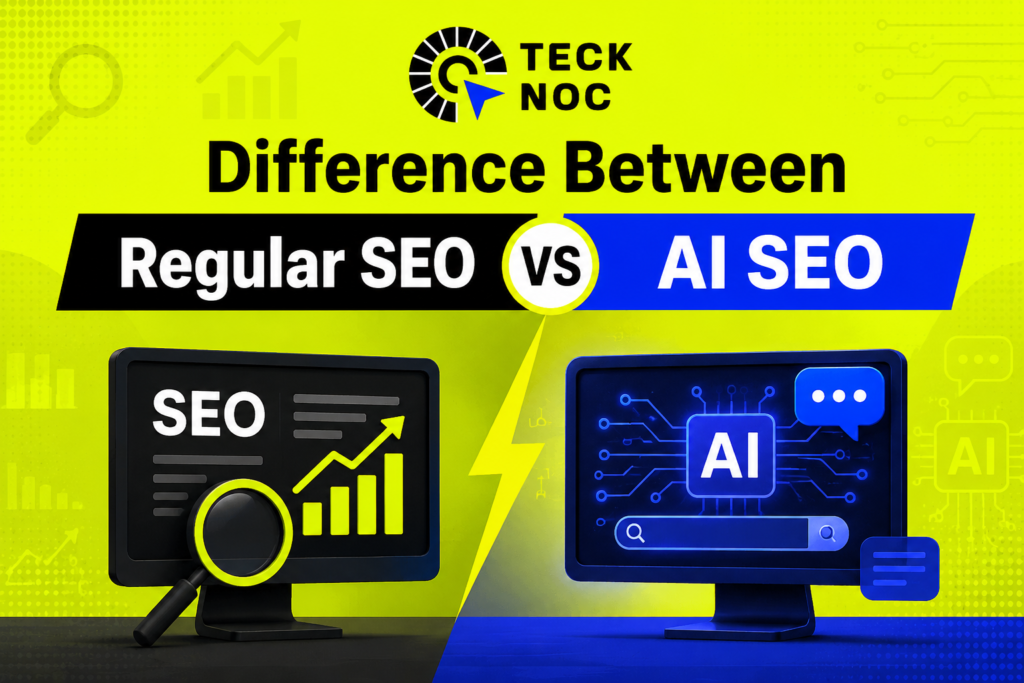
Search has changed. The way people find businesses online in 2025 looks nothing like it did five years ago, and the gap between traditional SEO and AI SEO is at the center of that shift.
If you run a small business, a local service, or an ecommerce store, understanding this difference isn’t just useful. It directly affects whether people find you or your competitor.
What Regular SEO Does
Traditional SEO is built around a straightforward idea. You find keywords people search for, you build pages around those keywords, you earn backlinks, and Google rewards you with rankings.
It works. It still works. But it has limits.
Regular SEO is reactive. You research what people searched for last month, optimize for those terms, and wait to see where you land. A law firm targeting “divorce attorney in Austin” writes a page around that phrase, builds some links, and hopes to rank in the top three. A clothing store targets “women’s summer dresses” and does the same thing.
The problem is everyone is doing exactly that. Competition for high-value keywords is intense, the process is slow, and the strategy doesn’t adapt on its own. You update it when you get around to it.
What AI SEO Actually Means
AI SEO isn’t a replacement for traditional SEO. Think of it as SEO that thinks faster and works smarter.
Here’s a real world example. Say you run an accounting firm that works with small business owners. Traditional SEO would have you targeting phrases like “small business accountant near me” or “bookkeeping services [city].” You’d write pages, build links, and track rankings monthly.
With AI SEO, the approach goes deeper. AI tools analyze search intent across thousands of related queries, not just the obvious ones. They identify that a business owner searching for tax help in March uses completely different language than someone searching in October. They find content gaps your competitors haven’t covered. They flag technical issues on your website before those issues hurt your rankings. And they help you structure content so it gets picked up not just by Google, but by AI tools like ChatGPT, Perplexity, and Google’s AI Overviews.
That last part is where the real shift is happening.
The Rise of AI-Powered Search
When someone asks Google a question today, they increasingly get an AI-generated answer at the top of the page before any website links appear. When someone asks ChatGPT “what’s the best payroll software for a small business” or “who’s a reliable contractor in my area,” it pulls from structured, authoritative sources to give a recommendation.
If your content isn’t structured to answer questions directly, if your business information isn’t consistent across the web, and if your site doesn’t signal authority to AI systems, you won’t show up in those answers. You’ll be invisible to a growing number of people who never scroll past the AI response.
Traditional SEO doesn’t account for this. AI SEO is built around it.
Why This Matters for Small and Medium Businesses
Large brands have entire teams managing their search presence. Small and medium businesses are competing against that with limited time and budget.
This is where AI SEO solutions for small businesses change the equation. AI-powered tools can do in hours what used to take weeks. Keyword research, competitor gap analysis, content briefs, technical audits, and performance tracking all move faster and surface insights a manual process would easily miss.
For a local service business, that means showing up in more searches with less wasted effort. For an ecommerce store, it means finding product-level keyword opportunities that attract buyers, not just browsers.
The playing field levels out when your SEO strategy uses the same caliber of tools that larger businesses use.
A Simple Way to Think About It
Regular SEO is like fishing with one rod in a spot you’ve always used. You know it works, but you’re limited by time, location, and what you can see.
AI SEO is like using sonar. You can see where the fish actually are, which spots are being overfished by competitors, and where nobody else is casting yet. You’re still fishing. You’re just making far better decisions about where and how.
What You Should Actually Do
You don’t have to choose between traditional and AI SEO. The best approach combines both, where solid fundamentals like technical health, quality content, and backlinks are enhanced by AI-driven insights and optimization.
AI SEO services for small business work best when they’re part of a complete strategy, not a standalone tactic added onto a shaky foundation.
That’s the approach we take at Tecknoc. As a full service digital marketing agency, we combine proven SEO fundamentals with AI-powered tools to help small and medium businesses compete in a search landscape that moves fast and keeps changing.
If your current SEO strategy was built two or three years ago and hasn’t been updated since, it’s probably not built for how search works today.
Want to know where you stand? Talk to the Tecknoc team and we’ll show you exactly what needs to change.