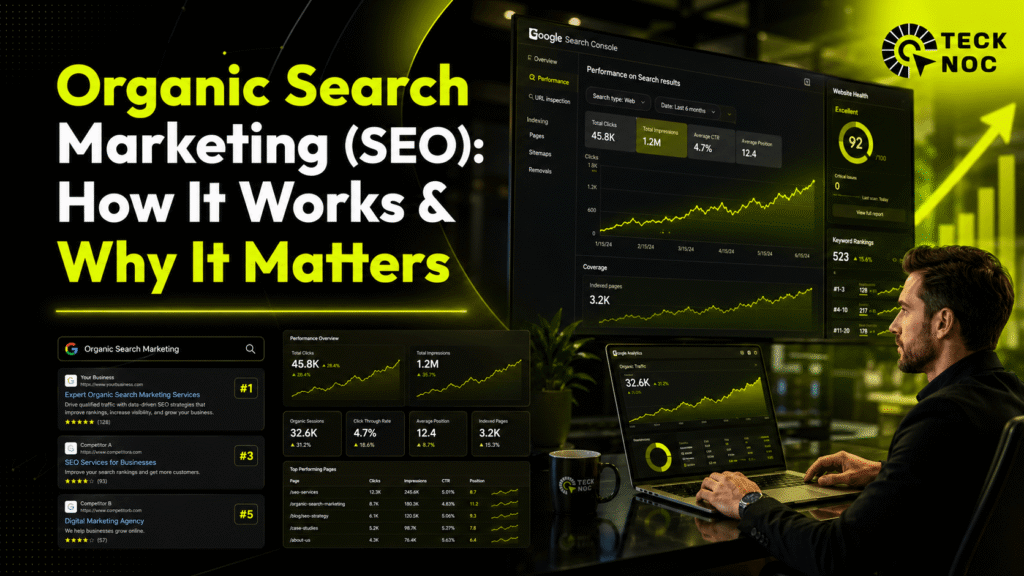
Every day, people in your area type questions into Google. “Best accountant near me.” “Who fixes commercial doors in [city]?” “Affordable web design for small businesses.” Those searches happen whether or not your business shows up in the results.
Organic search marketing SEO is the discipline of making sure your business appears in those results without paying for each click. And for small and medium businesses trying to grow without burning through an ad budget, it’s one of the most important investments you can make.
Organic search accounts for 53% of all website traffic, making it the single largest traffic source across the web. That’s more than paid ads, social media, and direct traffic combined. Understanding how it works and how to get more of it is not a technical exercise reserved for marketers. It’s a business decision with a direct line to revenue. BizIQ
What Is Organic Search Marketing (SEO)?
Organic search refers to the unpaid results that appear on a search engine results page when someone types in a query. When you search for something on Google, you typically see two types of results: paid ads at the top, marked with a small “Sponsored” label, and organic listings below them.
Organic listings are not bought. They are earned. Google ranks them based on how relevant, trustworthy, and useful the content is relative to what the person searched for. The goal of organic search marketing SEO is to make your website and content good enough, credible enough, and well-structured enough that Google ranks it prominently for the searches that matter to your business.
What organic search is not: it’s not a shortcut, and it’s not a one-time task. It’s a sustained effort to build online authority in your industry or local area so that the right people find you at the right moment.
How Organic Search Works: The Basics
Google’s job is to match search queries with the most useful, trustworthy results. It uses automated programs called crawlers to scan websites across the internet, index the content it finds, and rank that content based on hundreds of signals.
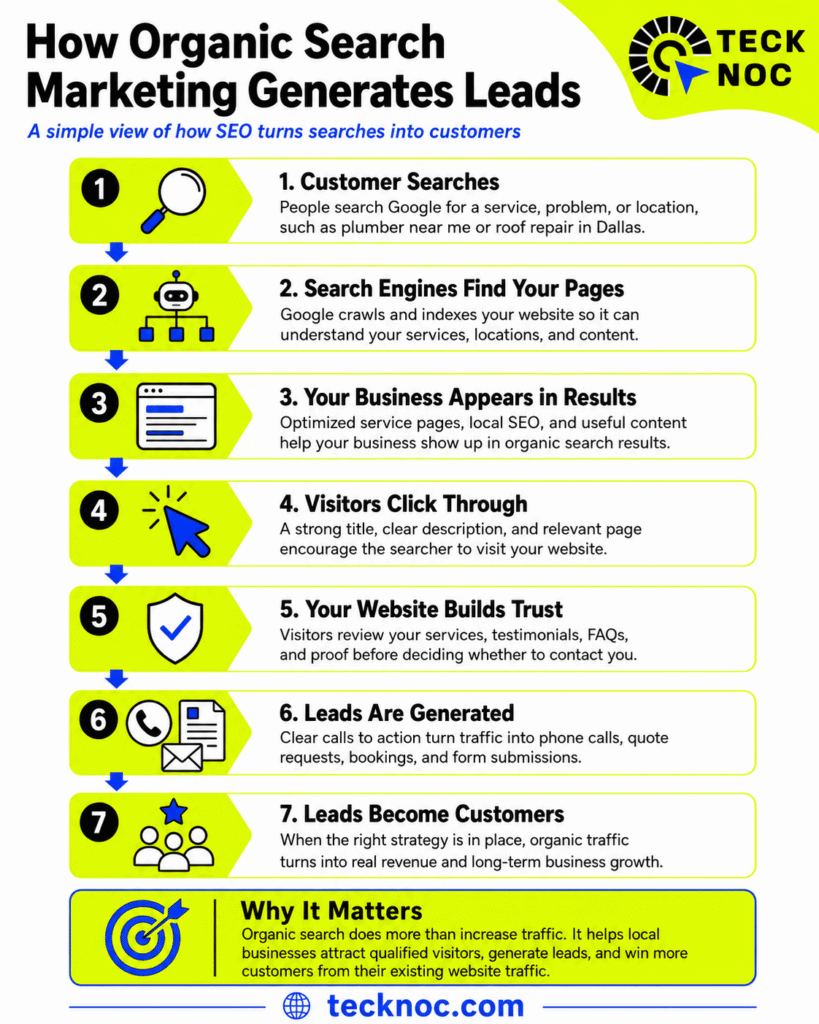
The most important signals fall into three categories.
Relevance. Does your content clearly address what the searcher is looking for? If someone searches “emergency roof repair contractor,” Google wants to see that your page is specifically about that topic, not just that it mentions roofing somewhere in passing. This is where keywords, page structure, and content quality come in.
Authority. Does Google trust your website? Trust is largely built through backlinks, which are links from other credible websites pointing to yours. A local business featured in a regional news article, a contractor listed in an industry directory, or a service company mentioned by a local chamber of commerce all pick up the kind of links that tell Google the site is legitimate.
User Experience. Does your website work well? Page speed, mobile usability, clear navigation, and low bounce rates all signal to Google that real users find your site helpful. Sites passing Core Web Vitals see 22% lower bounce rates, and page speed optimization delivers a $3.50 revenue increase per $1 spent on optimization. Digital Thrive
When your content is relevant, your site has authority, and your user experience is strong, Google ranks you higher. Higher rankings mean more organic search traffic, and more traffic from people actively looking for what you offer.
Organic Search vs. Paid Search: The Real Difference
Paid search, like Google Ads, puts your business at the top of results immediately. You pay every time someone clicks. Stop paying and the traffic stops.
Organic search works differently. It takes longer to build, typically 3 to 6 months to see meaningful movement and 6 to 12 months for stronger results, but once it’s established it keeps delivering without a cost-per-click attached to every visitor.
Organic leads cost around $31 each, while PPC leads cost around $181 each, meaning SEO generates leads at nearly 6 times lower cost than paid search. Beyond cost, the quality difference matters too. SEO leads close at 14.6%, compared to just 1.7% for outbound marketing. theStaccSeoProfy
That’s because organic search captures people who are actively looking. Someone who searched “licensed electrician in Columbus” and clicked your organic result has already decided they need an electrician. They’re not browsing. They’re looking to hire.
The practical takeaway: paid search is useful for immediate visibility and time-sensitive promotions. Organic search is the foundation that reduces your dependence on ad spend over time and builds a more cost-efficient customer acquisition channel.
Why Organic Search Matters Specifically for Small and Local Businesses
Large companies have marketing budgets that can sustain paid advertising indefinitely. Most small and medium businesses don’t. Organic search marketing SEO levels that playing field in a way few other channels do.
When a local service business ranks on the first page of Google for searches in its area, it appears alongside national brands, chain companies, and larger competitors, and sometimes above them. Local search intent is specific. Someone searching “locksmith in [city]” is not going to hire a company three states away. Geographic targeting works in your favor as a local business.
A regional dental provider increased organic traffic by 140% year-over-year through organic search optimization, allowing them to completely turn off paid search advertising. That’s the kind of outcome organic search can produce over time when it’s executed consistently. The Digital Bloom
For SMBs and local service businesses, the highest-value organic search activity is local SEO, which is the practice of optimizing specifically for searches that include a location or have local intent. This includes your Google Business Profile, local content on your website, consistent business information across directories, and reviews, all working together to make your business the most visible option when someone nearby is ready to buy.
What Organic Search Engine Optimization Actually Involves
Organic search engine optimization, often called SEO or natural search optimization, is the hands-on work of improving your website and online presence to rank higher in organic results. Here’s what that actually looks like in practice.
Keyword research. Before anything else, you need to understand what your potential customers are actually searching for. Not what you assume they’re searching for, but what the data shows. A roofing company might assume everyone searches “roof repair,” but the data might show that “roof leak repair near me” and “storm damage roof inspection” get more searches from people ready to hire right now. Keyword research finds those opportunities.
On-page optimization. This covers the structure and content of individual pages on your website. Page titles, headings, meta descriptions, URL structure, internal links, and the actual written content on each page all need to be aligned with what your target customers are searching for. Each service you offer should have its own dedicated page, not be mentioned in passing on a generic “Services” page.
Content creation. Organic search growth is directly connected to the quality and volume of content on your website. B2B companies that published 9 or more blog posts per month increased Google monthly website traffic by 35.8% year-over-year, compared to 16.5% for those blogging just 1 to 4 times monthly. For local businesses, this means answering the questions your customers actually ask, writing about local topics relevant to your industry, and building content that positions your business as a knowledgeable, trustworthy source in your area. SeoProfy
Technical SEO. This is the behind-the-scenes work that makes sure Google can access, crawl, and index your website properly. It includes site speed, mobile responsiveness, structured data markup, fixing broken links, and ensuring your site is secure. Technical issues don’t announce themselves, but they can silently suppress your rankings until they’re fixed.
Link building. Earning links from other credible websites is one of the strongest signals you can send to Google. For local businesses, this often comes through local press coverage, industry directories, partnerships with complementary businesses, and community involvement that gets mentioned online.
Google Business Profile optimization. For any business with a local customer base, your Google Business Profile is as important as your website for organic search visibility. It’s what appears in the map results when someone searches locally, and it’s where your reviews, photos, business hours, and services are displayed before someone ever visits your website.
What Organic Search Results Look Like in 2025 and Beyond
The organic search landscape has shifted meaningfully over the past two years. AI Overviews now appear at the top of many search results pages, summarizing answers before showing traditional organic listings. Zero-click searches, where someone gets their answer directly from Google without clicking, have become more common for informational queries.
This has caused some concern in the marketing world, but the data tells a more measured story. A comprehensive study analyzing over 40,000 of the largest US websites found that organic search traffic declined by only 2.5% year-over-year in 2025, not the dramatic collapses frequently cited in industry commentary. Organic results still capture approximately 90% of all clicks from Google, with paid ads receiving just 10%. ALM Corp
For local service businesses specifically, the impact has been limited. AI Overviews tend to affect informational searches more than transactional or local ones. Someone searching “how do gutters work” might get an AI summary. Someone searching “gutter installation near me” still gets local map results and organic listings with a direct path to contact a business.
The shift that matters most is this: organic search now feeds into more channels than just website clicks. When AI tools recommend local businesses, they pull from structured online data including your Google Business Profile, reviews, website content, and citation consistency. Optimizing for organic search today means you’re also building visibility in AI-generated recommendations.
How to Measure Organic Search Performance
You can track organic search performance directly in Google Analytics and Google Search Console, both free tools.
In Google Analytics, organic search traffic shows you how many visitors arrived at your site from Google and other search engines. You can see which pages they landed on, how long they stayed, and whether they completed a desired action like filling out a contact form or calling your business.
In Google Search Console, you can see exactly which search queries triggered your website to appear in results, how many impressions you got, how many people clicked, and what your average position was. This data tells you what’s working and where the opportunities are. As covered in our post on whether your SEO agency is actually working, Search Console data is one of the clearest ways to hold an agency accountable for real results.
The metrics that matter most for a local service business:
Organic traffic trend over 3 to 6 months. Click-through rate on your most important pages. Rankings for your key local service keywords. Calls and form submissions attributed to organic search. Local map pack appearances and actions, which Google Business Profile Insights tracks separately.
The ROI Case for Organic Search Marketing
The return on organic search investment is one of the most well-documented in marketing. A well-executed SEO campaign yields a median ROI of approximately 748%, meaning roughly $7.48 back for every $1 spent, and organic search generates 44.6% of all revenue attributed to digital channels. SeoProfy
SEO customer acquisition cost decreases by 60% over two years as content compounds and more pages rank. Unlike paid advertising where the cost per lead stays flat or rises with competition, organic search gets more efficient the longer it runs. theStacc
For a small business spending $1,500 per month on organic search marketing SEO, the question isn’t whether it works. The data is clear that it does. The question is whether the work is being done properly, consistently, and with the right strategy behind it.
Getting Started With Organic Search Marketing
The most common mistake small businesses make with organic search is treating it as a set-it-and-forget-it project. A website launched in 2020 with no updates since is not an organic search asset. It’s a missed opportunity.
Organic search growth requires ongoing attention: new content, technical maintenance, fresh reviews, profile updates, and link-building activity. The businesses that show up consistently at the top of local search results didn’t get there by accident. They got there because someone was paying attention and doing the work month after month.
At Tecknoc, we work with small businesses, local service companies, and SMBs across the US to build organic search visibility that actually translates into leads and customers. Whether you’re starting from scratch or trying to understand why your current results aren’t moving, we’ll give you a clear picture of where you stand and what it takes to improve.
Want to know how your business currently shows up in organic search? Talk to the Tecknoc team and we’ll pull the data and walk you through it.