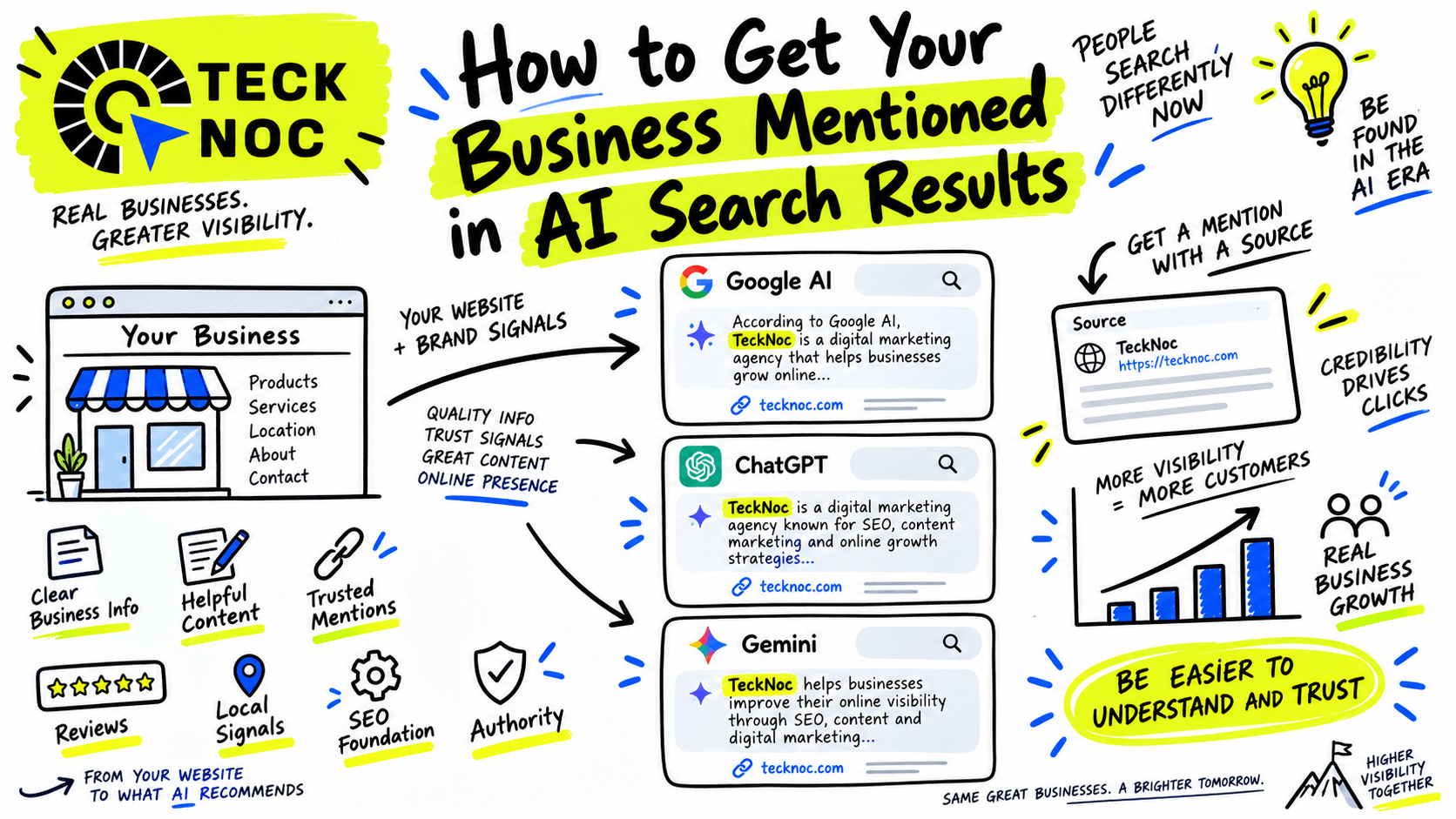
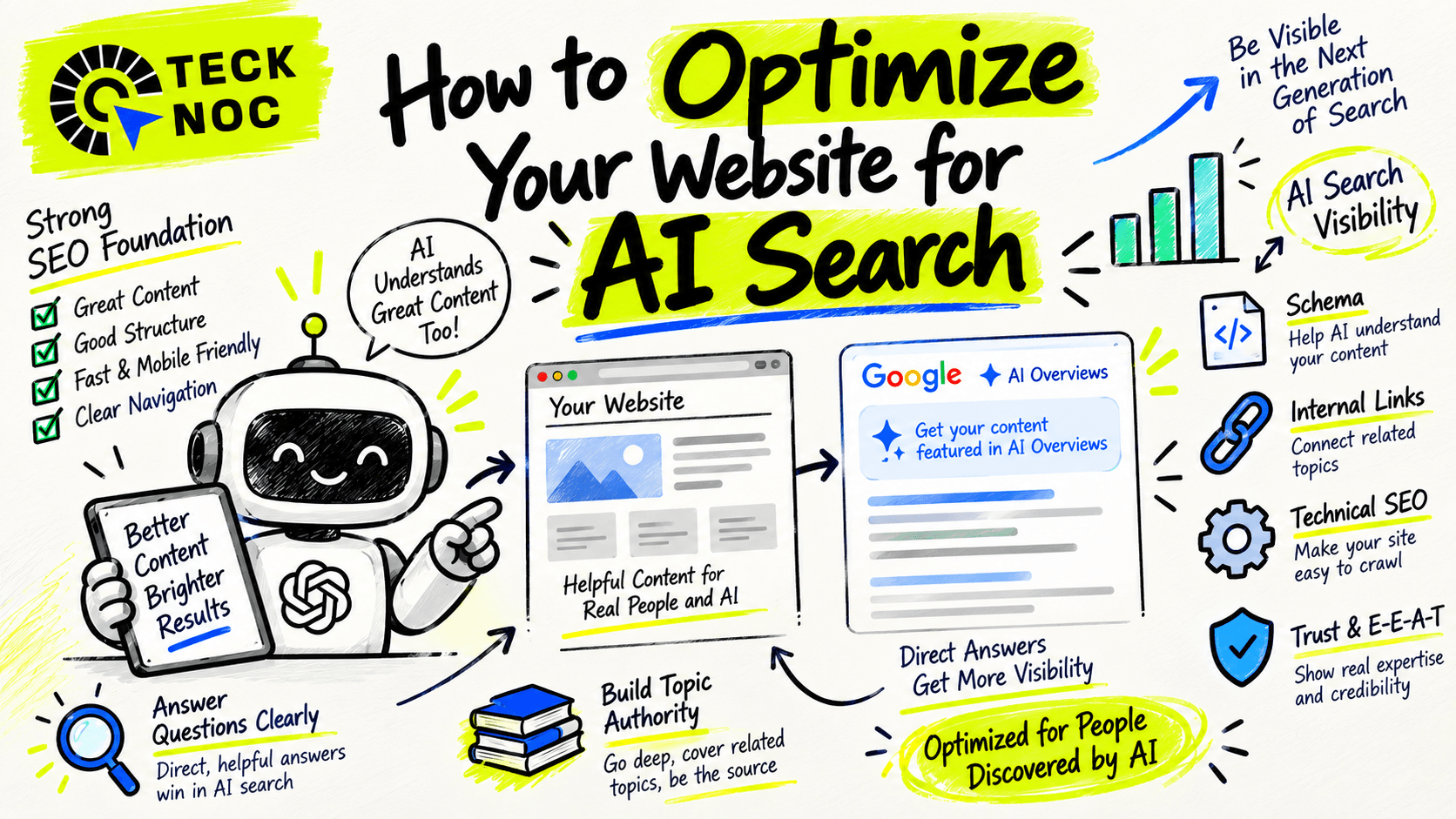
Quick Answer: To optimize your website for AI search, start with the same foundation that makes a website strong in traditional search: make your pages easy to crawl, publish useful content, answer questions clearly, build strong internal links, and give search systems reliable information about your business. Then strengthen those foundations with deeper topic coverage, clear brand signals, original expertise, structured data where appropriate, and content that AI systems can easily understand and reference.
There is no hidden AI SEO switch.
Google has specifically said that its existing SEO best practices remain relevant for AI Overviews and AI Mode. A page still needs to be indexed, eligible to appear in Google Search, useful to visitors, and technically accessible. Google also says there is no special schema or separate AI markup required to appear in these features.
That matters because a lot of AI search advice makes the process sound more complicated than it needs to be.
AI search is changing how people discover businesses and information, but the websites most likely to benefit are still the ones doing the fundamentals well.
What Is AI Search Optimization?
AI search optimization is the process of making your website easier for AI powered search systems to discover, understand, trust, and potentially reference when answering a user’s question.
Traditional search often gives users a list of pages to choose from.
AI search may go further. It can gather information from different sources, summarize the subject, compare options, answer follow up questions, and show supporting links.
Google says AI Overviews and AI Mode can use multiple related searches across different subtopics to build an answer. This means a page does not necessarily have to match one short keyword exactly to become relevant. Strong coverage of the wider topic can matter as well.
This changes how we should think about content.
Instead of asking only:
“What keyword should this page rank for?”
It is also worth asking:
“What questions around this subject can this page answer better than the alternatives?”
That is where AI search optimization starts becoming useful.
Is AI Search Optimization Different From Traditional SEO?
Yes, but not as much as some marketers make it sound.
Traditional SEO and AI SEO share the same basic foundation. Search engines still need to crawl the website, understand the content, assess its relevance, and decide whether it is trustworthy enough to show to users.
AI search adds another layer because the system may need to understand individual statements, relationships between topics, businesses, people, products, and locations before using information in an answer.
That makes clear explanations, strong context, topic depth, and reliable business information increasingly useful.
But it does not mean traditional SEO is dead.
If you want a more detailed comparison, our guide to Regular SEO vs AI SEO explains where the two approaches overlap and where they differ.
The mistake would be abandoning normal SEO to chase every new term associated with AI.
Google’s own position is straightforward: the SEO fundamentals that help a page perform in normal Search also remain relevant to AI Overviews and AI Mode.
Make Sure Search Engines Can Access Your Website
Before worrying about ChatGPT mentions or AI Overview citations, make sure search engines can properly access the website.
If Google cannot crawl or index an important page, AI optimization will not fix the underlying problem.
Google says pages need to be indexed and eligible to appear in normal Search before they can appear as supporting links in AI Overviews or AI Mode.
That means checking your technical foundation.
Your important pages should be crawlable. Canonical tags should point to the correct URLs. Internal links should make important content easy to discover. Mobile visitors should be able to use the website properly. Important information should also exist as readable text rather than being hidden inside graphics or scripts that provide little context.
This applies regardless of how the site was built.
We covered that issue separately in Can AI Generated Websites Rank on Google?. An AI generated website can rank, but it still needs the same technical and content foundations as any professionally developed site.
AI does not remove the need for technical SEO.
Answer the Main Question Early
One of the simplest improvements you can make is answering the user’s question before making them work for it.
If someone searches:
“How do I optimize my website for AI search?”
they should not have to read 600 words before discovering the answer.
Give them the answer first.
Then explain it.
This structure works well for human readers because they can understand the main point immediately and decide whether they want more detail.
It also makes the relationship between the question and answer clearer for search systems.
For example, instead of opening an article with a long history of artificial intelligence, you could say:
“To optimize a website for AI search, improve its technical SEO, publish clear and useful answers, build topic authority, strengthen trust signals, and make your business information consistent across the web.”
Then spend the rest of the article explaining exactly how to do those things.
Simple does not mean shallow.
The short answer gives users direction. The deeper sections provide the evidence and detail.
Create Content Around Real Questions, Not Just Keywords
Keyword research still matters, but AI search makes question research more important.
People speak to AI tools differently from the way they traditionally typed queries into Google.
A user might once have searched:
“Texas SEO agency”
Now they may ask:
“Which SEO approach is better for a small Texas business trying to rank locally and appear in AI search?”
That is a more specific question.
Your website should be able to answer both types of search intent.
Start with the questions your customers actually ask before buying.
What does the service cost?
How long does it take?
What is included?
What is the difference between two options?
Who is the service suitable for?
What happens if the customer does nothing?
What mistakes should they avoid?
These are often more useful content opportunities than trying to publish another broad article targeting a two word keyword.
Build Topic Authority Instead of Publishing Random Blogs
One good article can rank.
A connected group of useful articles can build a much stronger understanding of what your website is about.
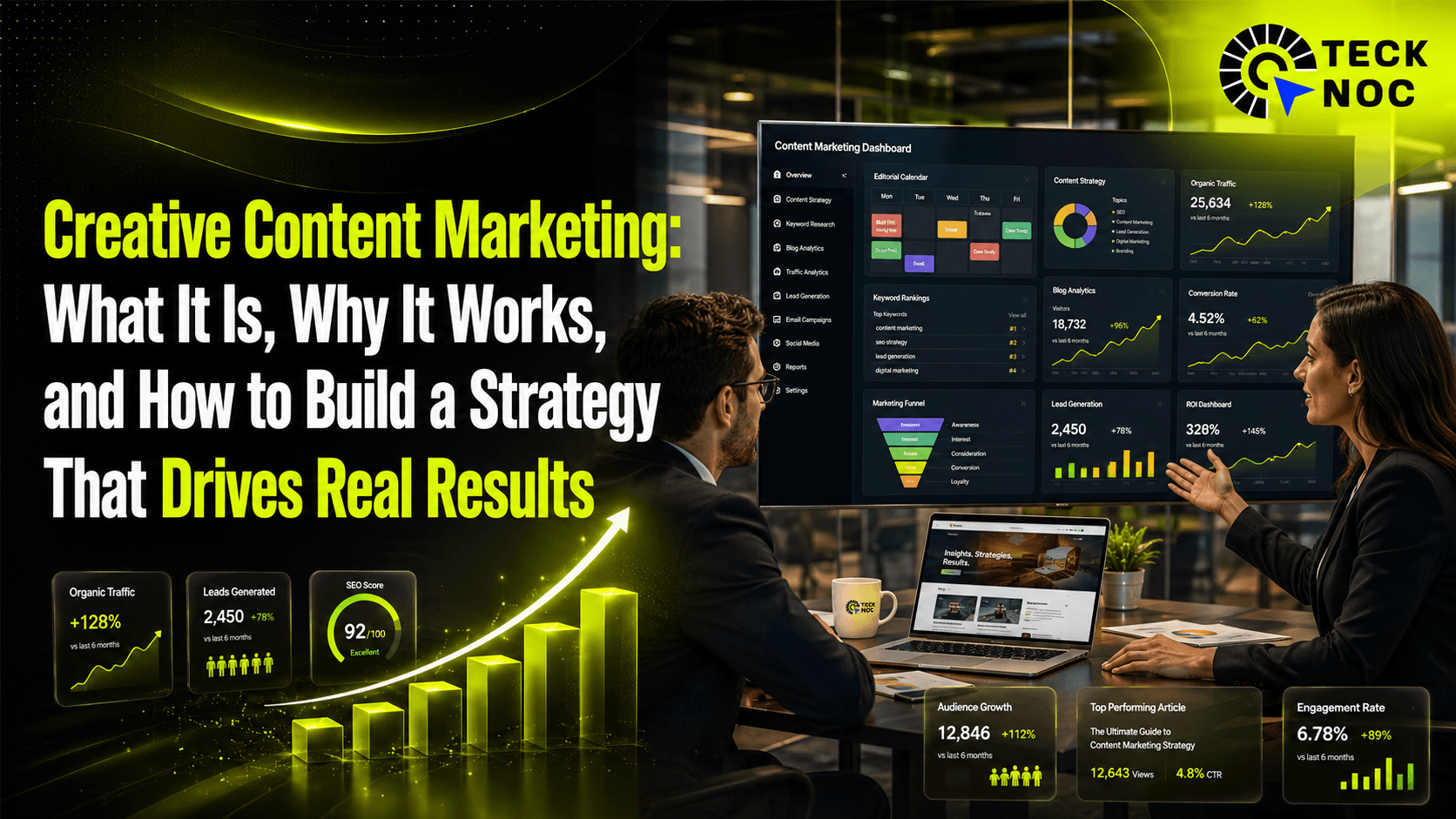
For example, TeckNoc’s AI SEO content can cover connected questions such as whether AI content can rank, whether AI websites can rank, how AI SEO differs from regular SEO, and how businesses can optimize for AI search.
Each article solves a different problem, but they support the same broader subject.
That creates a content cluster rather than a collection of unrelated blog posts.
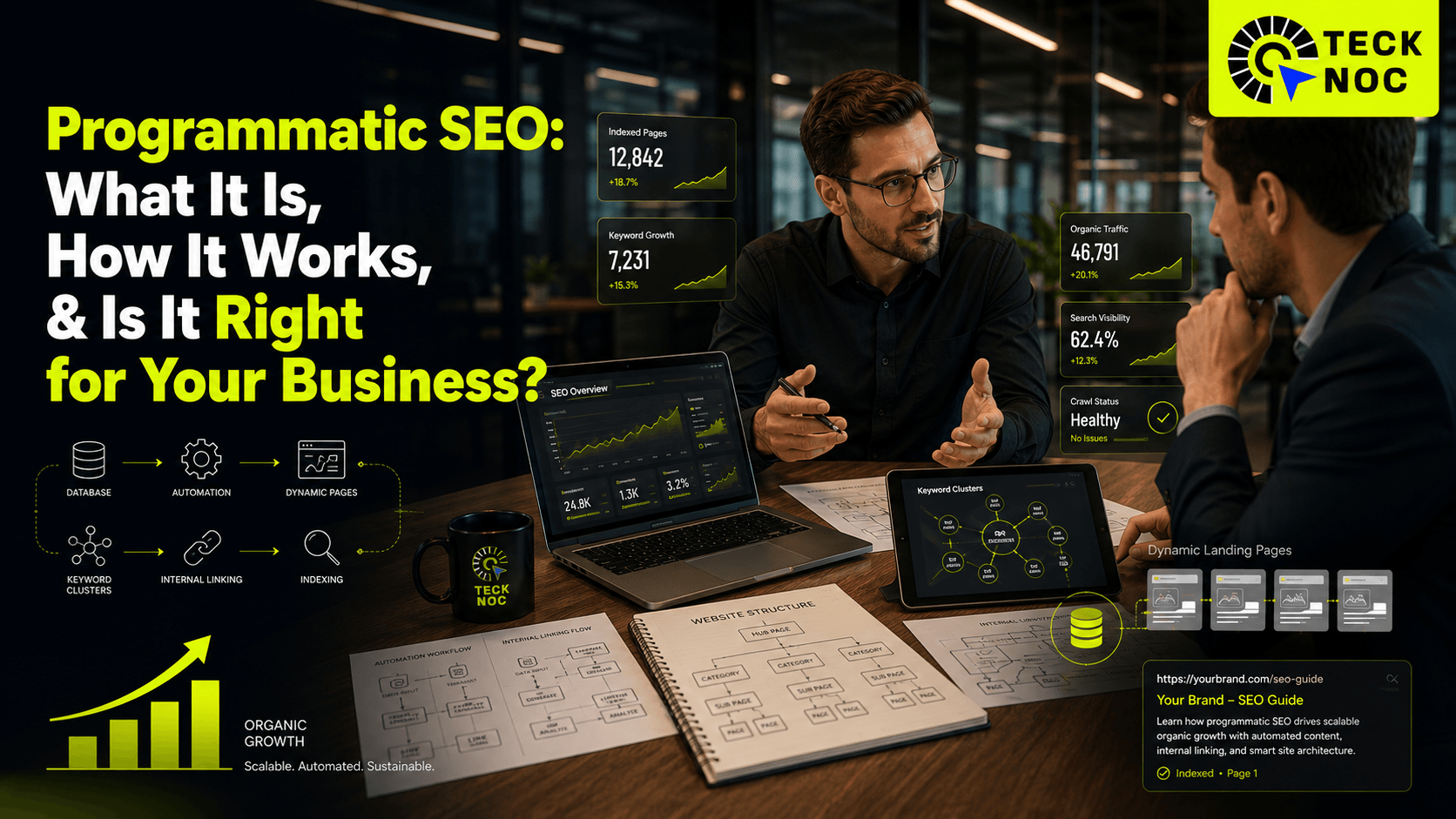
Your website might have a main SEO service page supported by articles about technical SEO, AI search, content quality, local search, rankings, and search strategy.
Those pages should link naturally to one another.
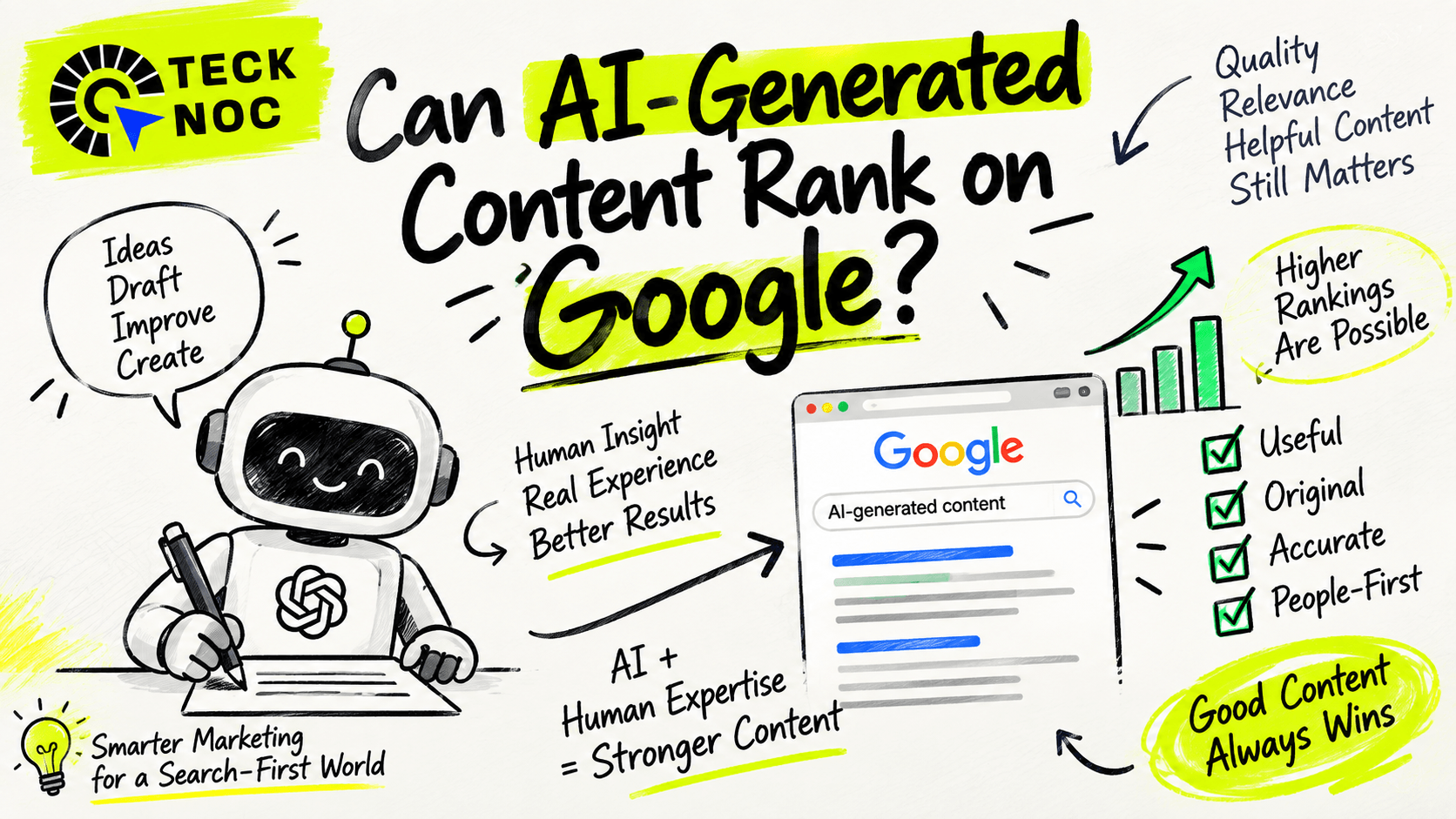
If you are using artificial intelligence during content production, quality control still matters. Our guide Can AI Generated Content Rank on Google? explains why AI itself is not the problem and why generic, unedited content often adds little value.
The objective is not to publish the highest number of articles.
It is to become genuinely useful within the topics your business wants to be known for.
Add Information AI Cannot Simply Repeat From Everyone Else
This is where many websites lose their advantage.
If your article says exactly what ten other articles say, there is little reason for a reader to choose yours.
There may also be little reason for an AI system to treat your page as an especially useful source.
Original value can come from your actual experience.
A digital marketing company might explain how it conducts keyword research, how it decides whether an existing page needs updating, what it checks during a technical audit, or what common mistakes it repeatedly finds on client websites.
A landscaping company could explain the installation process it actually uses.
A software company could publish original product comparisons, technical documentation, experiments, or data from its own platform.
Google’s people first content guidance asks whether content demonstrates first hand expertise and whether it provides substantial value compared with other pages in search results. It also warns against simply summarizing what others have already said without adding much value.
You do not need to invent case studies to demonstrate expertise.
Explain what you genuinely know.
That is far more useful than adding vague claims that cannot be verified.
Make Your Business Easy for AI Systems to Understand
A website should make the basics about the business obvious.
Who are you?
What do you do?
Where do you operate?
Who do you serve?
What makes your company relevant to this subject?
These details should not contradict one another across different pages.
If one page uses one company name, another uses an old brand variation, and external listings contain different business information, the overall picture becomes less clear.
Your About page, Contact page, service pages, author profiles, Google Business Profile, social profiles, and external business listings should support a consistent understanding of the company.
This is sometimes described as entity optimization.
You do not need to make the terminology complicated.
The practical goal is simply to make it easy for search systems to understand that your brand is a real business associated with specific services, expertise, locations, and information.
Use Internal Links to Explain Relationships Between Pages
Internal links are not just navigation.
They help search engines understand which pages are related and which pages matter most.
Google specifically includes making content easy to find through internal links among its recommendations for sites that want visibility in AI features.
Suppose this article discusses the importance of technical SEO.
A natural internal link can point readers toward a service page where they can learn how TeckNoc handles SEO.
For businesses evaluating SEO Services Texas, that connection helps users move from educational information to a relevant service without turning the article into an advertisement.
The anchor text should explain where the link goes.
Avoid inserting the same exact keyword into every article just because you want the destination page to rank.
Internal linking works best when it genuinely helps the reader continue their journey.
Use Structured Data Correctly, But Do Not Expect It to Do the Work for You
Structured data can help search engines understand information on a webpage.
Depending on the page, this might include Organization, Article, LocalBusiness, Breadcrumb, Product, or other relevant schema types.
But structured data is not an AI ranking shortcut.
Google says structured data should match the visible information on the page, and it specifically states that websites do not need special AI schema or new machine readable files to appear in AI Overviews or AI Mode.
So use schema where it accurately describes the content.
Do not add markup simply because somebody claims a new schema type will make ChatGPT recommend your business.
There is no guaranteed markup that does that.
Strengthen Your E E A T Signals
Experience, expertise, authoritativeness, and trustworthiness are useful quality concepts when reviewing your content.
Google says E E A T itself is not one single ranking factor, and it places particular importance on trust.
For a business website, trust can be strengthened through straightforward things.
Show who wrote or reviewed important content.
Provide an About page that explains the company.
Avoid unsupported claims.
Correct outdated information.
Use genuine examples where available.
Make contact details easy to find.
Explain how services actually work.
Reference reliable external sources when factual claims need support.
AI search does not remove the need for trust.
If anything, a system summarizing information for users needs reliable sources to work from.
Optimize Service Pages, Not Only Blog Posts
AI search optimization is often discussed as a content marketing strategy, but service pages matter too.
A weak service page might contain 300 words saying the company is professional, reliable, experienced, and ready to help.
That tells the user almost nothing.
A stronger service page answers the questions that affect buying decisions.
What exactly is included?
Who is the service for?
What problems does it solve?
How does the process work?
How is the service different from alternatives?
Where is it available?
What should the customer expect next?
Those questions create useful information that both users and search systems can understand.
For example, the TeckNoc Digital Marketing Company Texas page should not exist only to target a keyword. It should clearly explain what TeckNoc provides, which businesses it serves, how its services fit together, and what a potential client should expect.
That is more useful than repeating “digital marketing company Texas” throughout the page.
Can You Optimize for Google AI Overviews and AI Mode?
Yes, but not by using a separate Google AI SEO formula.
Google says there are no additional requirements to appear in AI Overviews or AI Mode beyond the existing requirements for Google Search. Pages need to be indexed, eligible for Search, and follow normal SEO and content quality practices.
That means the work is familiar.
Create genuinely useful pages.
Make them easy to crawl.
Use clear internal links.
Provide a good page experience.
Keep important information available as text.
Use structured data accurately.
Keep business information current.
Then improve the quality of the information itself.
There is no guaranteed method for forcing Google to cite a particular page in an AI Overview.
Anyone promising guaranteed AI citations is promising something they do not control.
What About ChatGPT, Perplexity, Gemini, and Other AI Search Tools?
Different AI platforms use different systems, sources, partnerships, indexes, and retrieval methods.
That means there is no single optimization trick that guarantees visibility everywhere.
The safer strategy is to improve the underlying signals that make your business useful wherever people search.
Publish strong information on your own website.
Build a recognizable brand.
Earn relevant mentions from other websites.
Keep your company information consistent.
Create pages that answer specific questions.
Maintain technically accessible content.
The objective should not be to manipulate one AI tool.
The objective should be to make your company a credible source within its subject.
That approach is more durable because the platforms will continue changing.
Earn Authority Outside Your Own Website
Your website is where you control the message.
But your own website saying that you are an expert is not the same as independent websites recognizing your expertise.
External authority can come from relevant backlinks, industry mentions, press coverage, business directories, professional profiles, partnerships, reviews, expert contributions, and other legitimate references.
This does not mean collecting hundreds of low quality directory links.
Relevance matters.
If several credible sources consistently associate your business with a particular service or subject, that creates a stronger web presence than your own website making the claim alone.
For a broader strategy, AI search should sit alongside SEO, content, reputation, paid media, and other channels rather than being treated as an isolated activity. That is the approach we take when planning work around a Digital Marketing Company Texas strategy.
Keep Your Content Accurate and Current
AI, SEO, and digital marketing change quickly.
An article published two years ago may still rank while containing advice that is no longer accurate.
That creates a trust problem.
Review important pages regularly.
You do not need to change the publication date every month or rewrite an article just to make it appear fresh. Google specifically warns against changing dates or adding large amounts of new content simply because you believe freshness itself will improve rankings.
Update a page when there is something meaningful to improve.
Replace outdated facts.
Add new information.
Remove recommendations that no longer apply.
Improve sections when users are clearly looking for answers the article does not provide.
Useful updates matter more than cosmetic updates.
Do Not Publish AI Content Without Human Review
Using AI to help produce content is not automatically a problem.
Publishing whatever the tool generates without checking it is.
AI can produce incorrect claims, outdated information, generic examples, invented statistics, and confident explanations that sound plausible even when they are wrong.
Every important article should therefore be reviewed by somebody who understands the subject.
Check factual claims.
Remove repetition.
Add real knowledge.
Make sure examples are accurate.
Ask whether the article actually answers the question better than what already exists.
That is the difference between using AI to support content production and letting AI become the entire content strategy.
How Do You Measure AI Search Visibility?
This area is still developing, so do not judge success using one metric.
For Google, Search Console remains important. Google states that traffic from AI Overviews and AI Mode is included within Search Console’s overall Web search reporting.
Beyond that, monitor whether the pages you are improving are gaining organic impressions, visibility for relevant queries, branded searches, referral traffic, engagement, leads, and conversions.
You can also manually review important AI search queries to see which businesses and sources are being referenced.
Do not become obsessed with whether ChatGPT mentioned your brand once.
The real question is whether your overall search visibility and business results are improving.
AI citations are useful signals.
They are not the entire objective.
How Long Does AI Search Optimization Take?
There is no fixed timeline.
A technically strong website with existing authority may see new pages discovered relatively quickly.
A new website entering a competitive industry may need considerably more time.
Results depend on factors such as your existing authority, content quality, technical health, competition, brand recognition, external mentions, and how well the website already covers the subject.
That is another reason AI search optimization should not be treated as a one time project.
It belongs inside the wider SEO process.
Build the technical foundation.
Publish better information.
Strengthen important pages.
Earn authority.
Review performance.
Then keep improving what users actually need.
Common AI Search Optimization Mistakes
The biggest mistake is treating AI SEO like an entirely new marketing channel with completely different rules.
It is not.
Other common problems include writing only for AI systems, producing large amounts of generic AI content, neglecting technical SEO, using schema that does not match the page, building thin content simply to target every possible question, and believing that mentions in one AI tool automatically mean the strategy is working.
The best AI search strategy is usually less dramatic.
Make your website technically sound.
Create information worth referencing.
Explain your expertise clearly.
Build authority around the subjects connected to your business.
Then make those relationships easy for both people and search systems to understand.
Final Thoughts: How Should You Optimize Your Website for AI Search?
To optimize your website for AI search, do not start by searching for a secret AI ranking trick.
Start with SEO.
Make sure search engines can access your pages. Create useful content around real questions. Give direct answers before deeper explanations. Build connected topic clusters. Add first hand knowledge. Keep your business information consistent. Strengthen internal links. Use structured data accurately. Earn relevant mentions outside your own website.
Then keep improving those signals over time.
Google’s own guidance supports this approach. The fundamentals of good SEO still apply to AI Overviews and AI Mode, and there is no separate technical requirement or special AI schema needed to participate.
AI search optimization is not about writing content for machines.
It is about making useful, trustworthy information easier for both people and search systems to understand.
Need Help Improving Your Visibility in Search?
Search is changing, but businesses still need a strong foundation before they can compete in either traditional or AI driven results.
TeckNoc’s SEO Services Texas focus on technical SEO, content strategy, search intent, internal linking, and the wider signals that help businesses improve their search visibility.
If you want to understand where your website currently stands and what should be improved first, Request a Consultation.
FAQs
What is AI search optimization?
AI search optimization is the process of improving a website so AI powered search systems can more easily discover, understand, and use its information. It builds on traditional SEO through strong technical foundations, useful content, clear answers, topic authority, reliable business information, internal links, and external trust signals.
How do I optimize my website for AI search?
Start with technical SEO and make sure important pages can be crawled and indexed. Then publish content that directly answers real questions, build related topic clusters, add original expertise, strengthen internal links, use accurate structured data, keep business information consistent, and earn credible mentions outside your website.
Does traditional SEO still matter for AI search?
Yes. Traditional SEO remains the foundation of AI search visibility. Google says the same core SEO practices continue to apply to AI Overviews and AI Mode, including crawlability, internal linking, useful content, page experience, structured data accuracy, and keeping important business information current.
How do I get my website mentioned in ChatGPT?
There is no guaranteed method for making ChatGPT mention a website. Focus on publishing reliable information, building a recognizable brand, earning credible mentions and links, keeping important business details consistent, and creating content that clearly answers the questions people ask within your area of expertise.
How can my website appear in Google AI Overviews?
Your page first needs to be indexed and eligible to appear in Google Search. Google says there are no additional technical requirements for AI Overviews. Strong SEO fundamentals, useful content, internal links, page experience, accurate structured data, and clear information remain the recommended approach.
Do I need special schema for AI search?
No special AI schema is required for Google’s AI Overviews or AI Mode. Google recommends using normal structured data where appropriate and making sure the markup accurately matches what users can see on the page.
Is AI SEO replacing traditional SEO?
No. AI search changes how information can be presented and discovered, but many of the same SEO foundations still apply. Technical accessibility, content quality, search intent, internal linking, authority, and trust remain important. AI SEO extends these practices rather than replacing them.
Can AI generated content help with AI search optimization?
Yes, AI can assist with research, outlining, drafting, and content organization. The final content should still be reviewed for accuracy, originality, usefulness, and real expertise. Publishing generic AI output without meaningful human input gives users and search systems little reason to prefer your page over existing sources.