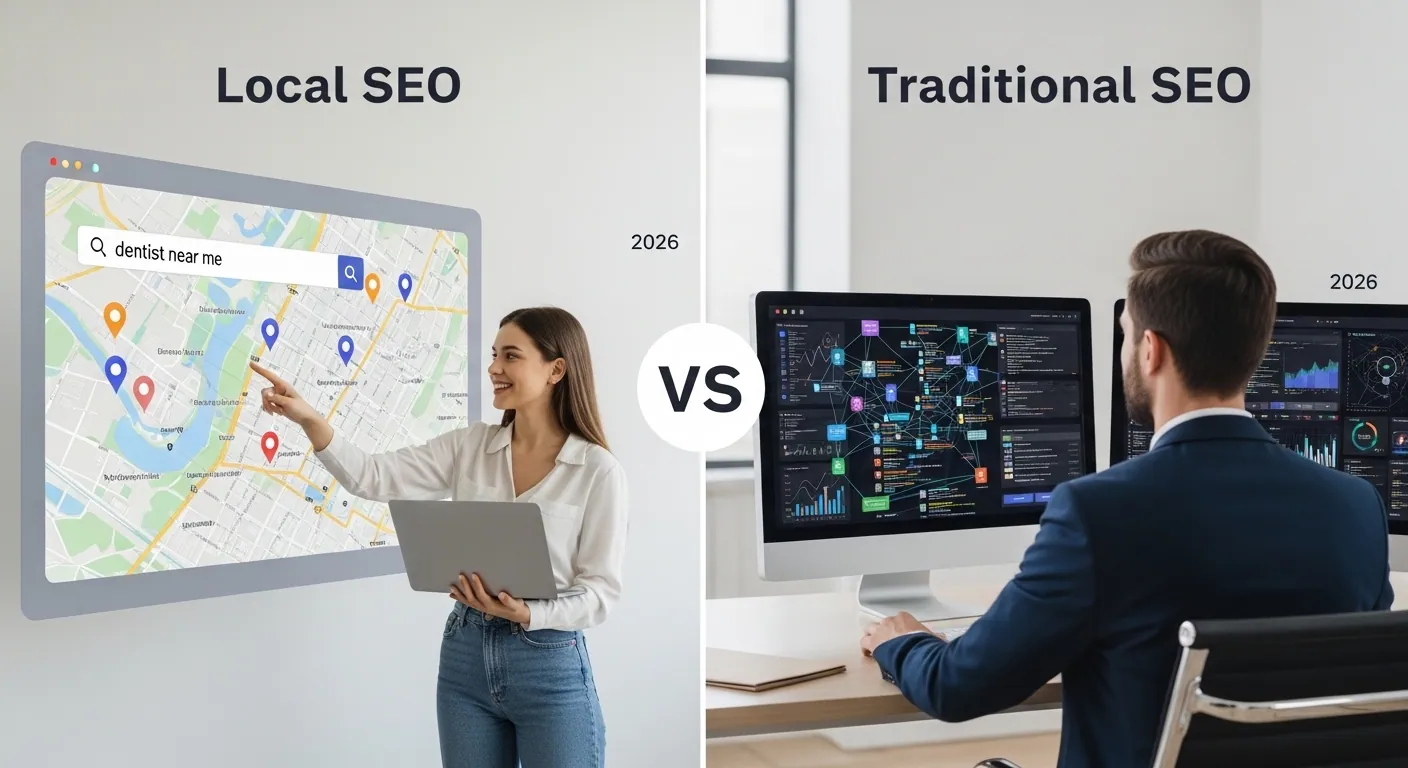
A national e-commerce brand selling organic coffee might focus on ranking for broad terms like “best espresso beans” to reach customers across the country. Meanwhile, a local cafe in Seattle is fighting a different battle: appearing in the google local pack when a nearby tourist searches for “coffee near me.” While both are using search engine optimization, their tactical playbooks are worlds apart.
A national brand might focus on ranking for broad terms like espresso beans to reach customers across the country. Meanwhile, a local cafe is fighting to appear in the google local pack for coffee near me. Understanding Local SEO vs Traditional SEO: What’s the Difference? is vital, and following a dedicated local seo guide for small businesses is the best way to ensure you are targeting the right audience for your specific business model.
Defining the Core Objectives of Each Strategy
In 2026, the primary differentiator between these two approaches is the nature of the search intent. One answers the question of “what” or “how,” while the other answers “where” and “when.”
Key Strategic Distinctions
- Target Audience: Traditional SEO targets a national or global audience, while Local SEO focuses on hyper-local customers within a specific visibility radius.
- Primary Battleground: Traditional SEO competes for the “blue links” in organic search results. Local SEO prioritizes the map pack rankings and googles maps.
- Optimization Assets: Traditional SEO relies heavily on backlink authority and long-form content. Local SEO depends on your google business profile and nap consistency.
- Primary Keywords: Traditional SEO uses broad or informational terms. Local SEO thrives on geo-targeted keywords and location-based intent.
- Conversion Metrics: Traditional SEO tracks traffic and leads. Local SEO measures call clicks, direction requests, and physical foot traffic.
Algorithm Priorities: Authority vs Proximity
Search engines use different sets of rules depending on whether a query has local intent. Understanding these internal mechanics is vital for any local SEO strategy.
Traditional SEO: The Authority Game
The traditional algorithm prioritizes domain authority and content depth. To rank for a national term, you need a high volume of quality backlinks and a site that demonstrates superior expertise on a broad topic. Success here is a “long game,” often taking six to twelve months of content optimization to see major movement.
Local SEO: The Proximity and Trust Game
For local queries, the algorithm shifts its focus to proximity, relevance, and prominence. Even if your website has lower overall authority than a national brand, you can outrank them locally if you are closer to the searcher and have stronger local trust signals, such as a high volume of verified google reviews. Many businesses follow strategies outlined in a comprehensive local SEO guide to better understand how local rankings work and how to improve visibility in their service area.
Content Strategy: Universal vs Hyperlocal
How you write and structure your content changes fundamentally based on whether you are targeting a local or national market.
Developing Universal Content
Traditional SEO content is designed to be “evergreen” and useful to anyone, regardless of their location. It focuses on solving problems, comparing products, and building topical authority. For example, a guide on “how to maintain a lawn” is a traditional SEO asset.
Mastering Hyperlocal Content
Local SEO requires location landing pages that mention specific neighborhoods, local landmarks, and regional challenges. Instead of a general guide, you might write about “the best grass types for North Texas soil.” This geo-targeted content signals to search engines and AI assistants that you are a local specialist.
Local vs Traditional Search Real Estate
Where your business appears on the search engine results page (SERP) determines the type of customer you attract.
The Organic “Blue Links”
Traditional SEO efforts aim for the standard organic results. This area is highly competitive and often dominated by big brands and publishers. Winning here requires meticulous technical SEO and high-level content clusters.
The Coveted Local Pack
Local SEO targets the three-pack map listing that appears above traditional results for most local queries. Because this section includes star ratings and a “Call” button, it captures the majority of local search traffic from mobile users who are ready to buy immediately.
| Feature | Local SEO | Traditional SEO |
| Search Intent | Immediate/Physical | Informational/Broad |
| Main Ranking Factor | Proximity & GBP Activity | Backlinks & Content Depth |
| Search Results Area | Google Local Pack | Organic Search Results |
| Key Metric | Store Visits / Calls | Website Traffic / Leads |
| Competition Level | Regional Competitors | National/Global Competitors |
Comparing ROI and Results Timelines
For a small business, the speed of results is often the deciding factor in choosing a small business local SEO plan over a broader strategy.
Speed of Local SEO Results
Because you are only competing with businesses in your immediate area, local search optimization often yields results faster—typically within four to twelve weeks. The high local search intent of these users leads to a much faster ROI, as someone searching for a “plumber near me” is usually in need of an immediate service.
Long-Term Value of Traditional SEO
Traditional SEO is a slower build but offers infinite scalability. Once you establish authoritativeness for a broad term, you can attract thousands of visitors without paying for every click. This supports long-term growth and builds significant brand visibility across the country.
Frequently Asked Questions
1. Should I Use Both Local and Traditional SEO?
Most local businesses benefit from a hybrid approach. Use local search engine optimization to drive immediate calls and visits, while using traditional SEO to build long-term authority through a helpful blog that answers broader customer questions.
2. Is Backlink Building Different for Local SEO?
Yes. Traditional SEO focuses on high-authority national sites. Local link building prioritizes links from local news, chambers of commerce, and community blogs, which carry more weight for geographic relevance.
3. Does Social Media Impact Local SEO More Than Traditional?
Indirectly, yes. Local engagement on social platforms helps build prominence and brand visibility in your specific city, which Google uses as a signal for your real-world reputation.
4. How Does AI Impact These Strategies Differently?
AI tools like AI Overviews use traditional SEO to answer “how-to” questions and Local SEO data (from your google business profile) to recommend specific service providers nearby.
5. Why Is Local SEO Considered More Cost-Effective?
It targets a smaller, more relevant audience. Instead of spending your budget to reach everyone in the US, you are only spending to reach the few hundred people in your neighborhood who are actively looking for your service right now.
Conclusion
The choice between Local SEO vs Traditional SEO depends entirely on your business model. If you rely on local customers walking through your door or calling for a service, local search optimization is your most powerful growth lever. If you sell products nationwide, traditional SEO will build the necessary authoritativeness to compete on a larger stage. Understanding how to balance proximity with authority is the hallmark of a sophisticated local SEO strategy in 2026.