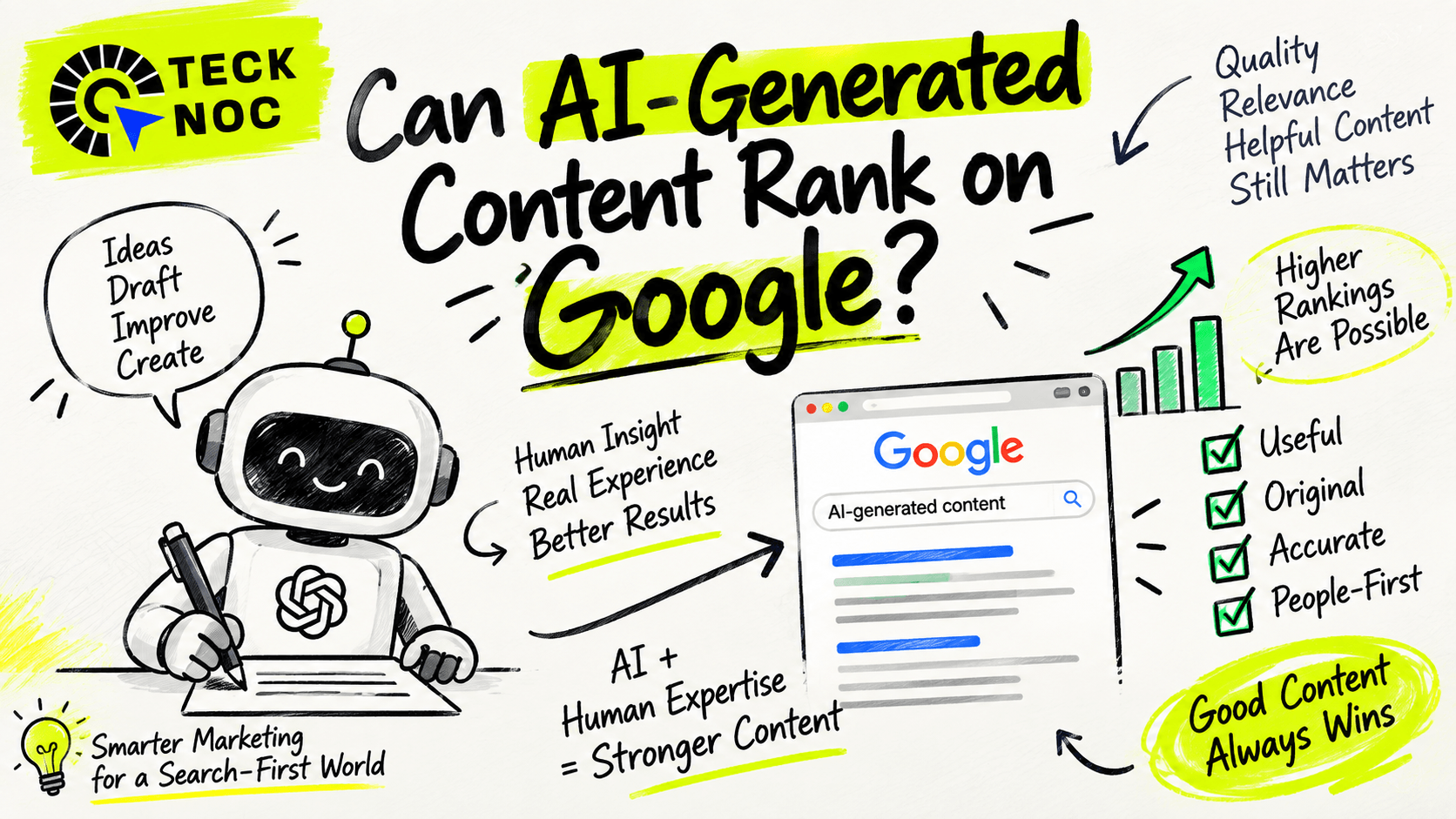
Quick Answer: Yes, AI generated content can rank on Google. Google does not automatically penalize a page simply because artificial intelligence was used to create it. What matters is the quality and purpose of the content. If AI generated content is accurate, useful, original, demonstrates real expertise, and satisfies the searcher’s needs, it can appear in Google Search. The problem starts when businesses publish large amounts of generic AI content with little original value simply to get more pages into search results.
AI has changed how businesses create content. A company can now produce an article in minutes that might previously have taken several hours to research and write. That makes AI useful, but it also creates a new problem. If everyone can produce similar content quickly, simply publishing more of it does not give your website an advantage.
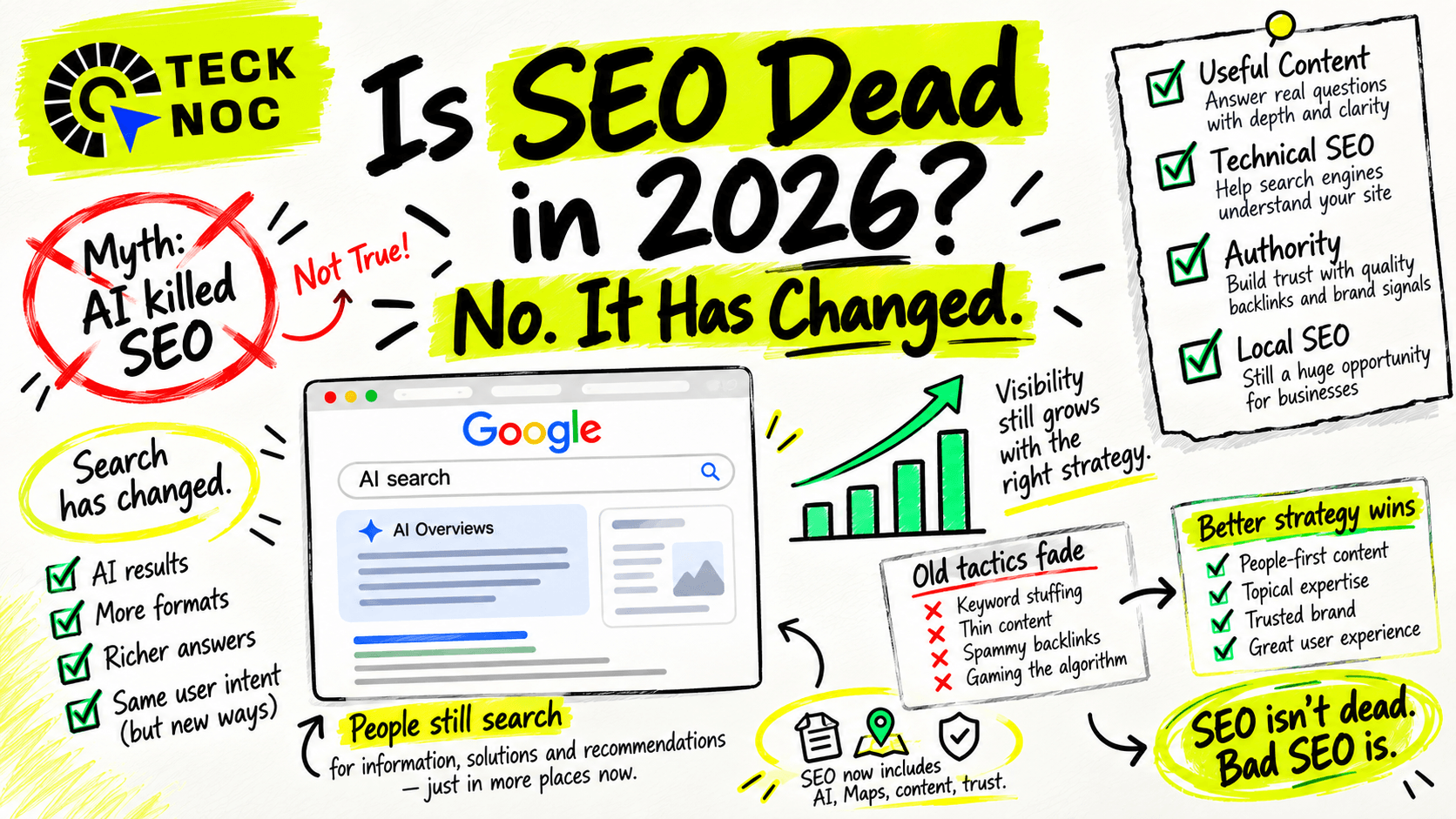
Google’s current guidance focuses on helpful, reliable, people first content. It also makes clear that using AI or automation to produce content is not the issue by itself. The concern is using automation to create content at scale without adding value, particularly when the purpose is to manipulate search rankings.
So the better question is not whether AI content can rank.
The better question is whether the content gives Google a reason to rank it.
Does Google Penalize AI Generated Content?
No. There is an important distinction between AI generated content and spammy content created with AI.
Google’s guidance does not say that businesses must avoid AI writing tools. Instead, its policies focus on the quality, usefulness, originality, and purpose of the content. Using generative AI to create content that provides little or no value at scale can fall under Google’s scaled content abuse policy.
For example, imagine two businesses selling the same service.
Business A asks an AI tool to produce 100 articles, publishes them with minimal editing, and targets slightly different keyword variations on every page.
Business B uses AI to help with research and drafting, then adds information from its own experience, checks the facts, includes relevant examples, answers the questions customers actually ask, and has an experienced person review the final article.
Both businesses used AI.
That does not make the content equally valuable.
The second approach has a much better foundation because the content was created to help the reader rather than simply increase the number of indexed pages.
Can AI Content Actually Rank on Google?
Yes, it can.
Google’s own documentation says its ranking systems are designed to prioritize helpful and reliable information created for people. It does not state that content becomes ineligible simply because AI was involved in its creation.
In practice, this means an AI assisted article can rank when it does the things a strong human created article should do.
It needs to answer the searcher’s question clearly. It needs to be factually sound. It should cover the subject properly without padding the page with unnecessary information. Most importantly, it should offer something useful that readers cannot get from dozens of almost identical pages.
This is where many businesses get AI content wrong.
They focus on producing content rather than producing useful content.
A 2,000 word article is not automatically better than a 900 word article. Adding a keyword to every other paragraph does not make an article more relevant. And publishing 50 AI generated articles does not automatically create topical authority.
Google specifically advises against creating content simply because you believe a particular word count or large publishing volume will improve rankings.
Why Does So Much AI Content Fail to Rank?
The problem is usually not the AI tool itself.
It is the process used to create the content.
A generic AI article often starts with the same research available to everyone else. The resulting article then repeats commonly available information in slightly different wording.
That creates what could be called commodity content.
For example, search for a basic topic such as “benefits of SEO for small businesses.” You will find hundreds of articles explaining visibility, traffic, credibility, leads, and conversions.
An AI tool can summarize those points very quickly.
But what does the reader gain from the 101st version?
Not much.
A stronger article might explain how an actual business should decide which pages to optimize first, what information to collect before starting SEO, which metrics matter after three months, and what mistakes commonly waste the marketing budget.
That is where experience becomes valuable.
Google’s people first guidance specifically asks whether content provides original information, research, analysis, or insights beyond what is obvious.
What Makes AI Generated Content More Likely to Rank?
There is no formula that guarantees a ranking. However, several characteristics make AI assisted content much stronger.
1. Start With Search Intent
Before writing anything, understand why someone searched for the topic.
Someone searching “can AI generated content rank on Google” wants a direct answer first. They may then want to understand Google’s position, potential risks, how to use AI properly, and what separates useful AI content from low quality content.
The article should follow that journey.
Do not make the reader work through five paragraphs before answering the question they came to ask.
2. Add Information AI Cannot Simply Recycle
AI can summarize information that already exists across the web.
Your business has something different: experience.
If your team has audited websites, worked on SEO campaigns, tested content strategies, reviewed Search Console data, or dealt with indexing problems, those experiences can make your content more useful.
Consider adding:
• Real examples from your work where appropriate
• Original observations
• Data you have permission to share
• Screenshots or demonstrations
• Practical recommendations
• Expert commentary
• Common mistakes you have seen
• Clear explanations of why a particular approach works
This is one of the biggest differences between using AI as a writing shortcut and using AI as part of a professional content process.
3. Fact Check the Output
AI tools can produce incorrect information.
That matters even more when writing about SEO because Google’s systems, policies, and search features change over time.
An AI tool may confidently provide an outdated recommendation or mix together information from different sources.
Every important claim should therefore be reviewed before publication.
For current Google guidance, use Google’s own documentation rather than relying on an AI generated summary. Google’s current documentation says AI features in Search continue to rely on the same foundational SEO practices used for traditional Search.
4. Make the Article Useful Without the Sales Pitch
Business blogs often make the mistake of turning every article into a service page.
A reader searching an informational question should be able to get a useful answer before being asked to contact a company.
That does not mean you should avoid mentioning your services.
It means the service should appear where it makes sense.
For example, a business that wants to use AI for content but does not know how to build a sustainable search strategy may benefit from professional AI SEO or broader SEO services.
The article should explain the problem first. The service becomes the logical next step.
Can AI Generated Content Demonstrate E E A T?
AI itself does not provide experience or expertise.
That responsibility remains with the people and organization behind the content.
Google describes E E A T as experience, expertise, authoritativeness, and trustworthiness, with trust being the most important aspect. Google also recommends making it clear who created the content and providing information that helps readers understand the expertise behind it.
That creates an important distinction.
An AI tool can help produce a draft.
It cannot honestly claim that your company completed a project, tested a strategy, interviewed a customer, analyzed a campaign, or solved a technical problem unless those things actually happened.
Those details need to come from real experience.
For TeckNoc, that means our strongest content should draw on genuine SEO and digital marketing knowledge rather than presenting generic AI summaries as expert advice.
AI Content vs Human Written Content
The debate is often framed as though businesses must choose one or the other.
That is too simplistic.
AI can be useful for brainstorming, research organization, outlining, summarizing information, identifying questions to investigate, and creating an initial draft.
Human expertise is still needed to decide what is accurate, what matters to the reader, what is missing, and what should actually be published.
Think of AI as a tool rather than the source of expertise.
A professional photographer uses editing software. That does not mean the software has the photographer’s experience.
A marketer can use AI to speed up parts of content production without handing over responsibility for the final information.
The quality of the process matters more than whether a particular paragraph began inside an AI tool.
Does AI Generated Content Need to Be Edited by a Human?
For business content where accuracy, reputation, and search performance matter, human review is highly advisable.
Editing should involve more than changing a few sentences.
A proper review should ask:
Does the article actually answer the searcher’s question?
Are the facts accurate and current?
Does the article contain information that is genuinely useful?
Are there unsupported claims?
Does the content reflect the company’s actual expertise?
Are examples real and verifiable?
Does the article sound like a knowledgeable business rather than a generic content generator?
Is anything repeated simply to increase word count?
This type of review can turn an average AI draft into a useful business resource.
How to Use AI for SEO Without Creating Spam
The safest approach is to use AI to improve your workflow, not to manufacture hundreds of pages.
Start with keyword research and search intent. Decide what the reader actually needs to know. Research reliable sources. Build an outline around the questions that matter. Use AI where it can save time, then add your own expertise, examples, analysis, and recommendations.
After that, review the finished article carefully before publishing.
This approach also makes it easier to build a consistent content strategy. Instead of asking an AI tool to produce another article every time you need content, you can identify gaps in your existing website and create resources that genuinely support your audience.
That is much closer to how sustainable search engine optimization should work.
Can AI Content Appear in Google’s AI Overviews and AI Mode?
Potentially, yes.
The same important distinction applies here. There is no separate requirement saying that content must be written entirely by a human before it can appear as a supporting result in Google’s AI features.
Google says the same foundational SEO practices remain relevant to AI Overviews and AI Mode. Pages need to be accessible, eligible to appear in Google Search, and provide helpful, reliable, people first content.
Google’s current guidance on generative AI search also emphasizes unique, valuable, non commodity content and points out that a distinctive viewpoint or first hand experience can make content more useful in these experiences.
That means businesses should not treat AI search as a completely separate game.
Strong fundamentals still matter.
A page needs to be crawlable and indexable. Its information needs to be useful. Its topic needs to match the searcher’s intent. The site should make important content easy to find through internal links.
There is no magic “AI search” button that makes weak content appear in AI results.
What Should Businesses Do With AI Content?
Do not stop using AI simply because some AI generated content performs poorly.
Instead, change how you use it.
Use AI where it makes your team more efficient. Keep people responsible for research, fact checking, strategy, expertise, and the final editorial decision.
The goal should not be to publish the most content.
The goal should be to publish content that deserves to be found.
That distinction is becoming more important as search engines become better at understanding content quality and as users increasingly ask longer and more specific questions.
Google’s own guidance for AI search makes the same broader point: unique and valuable content is more useful than content that simply repeats what is already available elsewhere.
The Bottom Line
So, can AI generated content rank on Google? Yes.
Google does not automatically reject content because AI was used to create it. The real issue is whether the finished content is useful, reliable, original, and created primarily for people.
AI can help businesses research topics, organize information and produce drafts faster. What it cannot replace is genuine expertise, first hand experience, editorial judgment, and responsibility for what gets published.
If you use AI to create more of the same content that already exists across the internet, you are unlikely to gain much from it.
If you use AI as a tool while adding real knowledge, original insights, accurate information and a clear understanding of your audience, it can become a valuable part of a modern SEO workflow.
That is the approach businesses should take as both traditional Google Search and AI powered search continue to evolve.
Need Help Building an AI Ready SEO Strategy?
AI is changing how people discover information, but the fundamentals of good SEO still matter. TeckNoc helps businesses build search strategies that combine technical SEO, useful content, on page optimization, and optimization for emerging AI search experiences.
If your business is producing content but struggling to turn it into organic visibility, our SEO services can help identify what is holding your website back and build a strategy around your actual search opportunities.
For businesses targeting customers across Texas, our SEO services in Texas can also be tailored around local competition, search intent, and the locations you want to grow in. Let’s Talk