Quick Answer: No, SEO is not dead in 2026. What has changed is how people search, where they search, and what search engines reward. AI Overviews, ChatGPT, Google AI Mode, social platforms, Maps, and other discovery channels have changed the search landscape, but businesses still need useful content, technically accessible websites, strong authority, local relevance, and clear information. SEO is evolving from simply ranking pages in Google into helping businesses become visible wherever customers search.
You have probably seen the claim before:
“SEO is dead.”
Now the argument usually sounds slightly different:
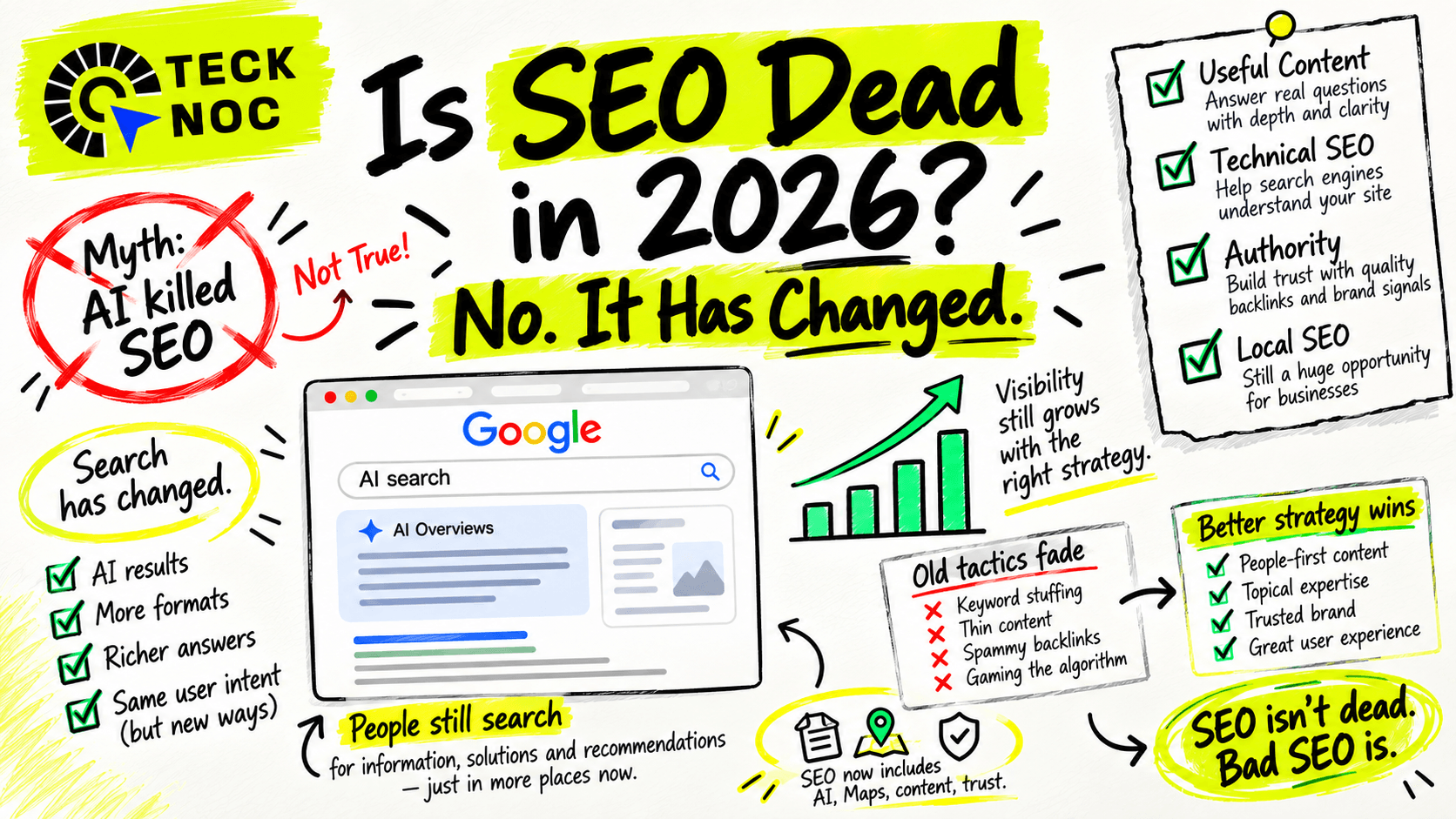
“AI killed SEO.”
It makes a good headline.
But it does not tell the full story.
SEO is not disappearing. Some old SEO tactics are becoming less effective, search behavior is becoming more fragmented, and businesses now have to think beyond traditional blue links.
That is a major change.
It is not the death of SEO.
Why Do People Keep Saying SEO Is Dead?
People have been predicting the death of SEO for years.
Every major change creates another version of the same argument.
Mobile search was supposed to kill it.
Social media was supposed to kill it.
Voice search was supposed to kill it.
Now AI is supposed to kill it.
There are genuine reasons why people are asking the question again in 2026.
Search results have changed significantly.
Users can now get information through:
- Google AI Overviews
- Google AI Mode
- ChatGPT
- Gemini
- Perplexity
- Google Maps
- YouTube
- social platforms
- marketplaces
Some searches no longer require a website click at all.
That can reduce traffic for certain informational queries.
But fewer clicks on some searches does not mean people have stopped searching.
It means the path between a question and an answer has changed.
Did AI Kill SEO?
No.
AI has changed SEO, but it has not removed the need for it.
AI systems still need information.
They need sources to understand:
- what a business does
- where it operates
- what services it offers
- what people say about it
- which pages are trustworthy
- which information is relevant to a question
That information often comes from websites, business profiles, structured data, reviews, citations, authoritative publications, and other publicly available sources.
So even when a customer does not click a traditional Google result, your online presence still matters.
Businesses now need to think about being discoverable in both traditional search and AI-driven search experiences.
We explain that in more detail in our guide on how to optimize your website for AI search.
Is AI Replacing SEO?
No. AI is changing the way SEO works.
Traditional SEO often focused heavily on questions like:
What keyword are we ranking for?
or:
Are we in position one?
Those questions still matter, but they are no longer the whole picture.
Businesses increasingly need to ask:
Does Google clearly understand what we offer?
Can AI systems identify our business as relevant to this topic?
Are we trusted enough to be mentioned?
Does our website actually help the customer make a decision?
Are we visible across Search, Maps, AI answers, and other discovery platforms?
SEO is becoming broader.
The job is no longer just to rank a page.
The job is to make a business easy to find, understand, trust, and choose.
What Has Actually Changed in SEO?
Search Results Are Becoming Answers
Google increasingly answers questions directly in the search results.
AI Overviews and AI Mode can summarize information before the user visits a website.
That means websites competing for purely informational clicks may see different traffic patterns than they did several years ago.
But it also creates another visibility opportunity.
A brand can potentially appear inside or alongside AI-generated answers even when the user does not interact with a traditional organic listing.
We cover this shift in how AI Overviews are changing SEO for businesses.
Average Content Is Much Easier to Produce
AI can create a basic article in seconds.
That means simply publishing 100 generic blog posts is no longer much of an advantage.
If everyone can produce average content cheaply, average content becomes less valuable.
Businesses need something better:
- first-hand experience
- original insights
- useful examples
- expert knowledge
- clear answers
- credible sources
- real business experience
Content still matters.
The standard is simply higher.
Search Is More Fragmented
Customers do not always start with Google anymore.
Someone looking for a restaurant may use Maps.
Someone researching a product may use TikTok or YouTube.
Someone comparing software may use ChatGPT.
Someone looking for a local contractor may still use traditional Google Search.
That means modern SEO increasingly overlaps with brand visibility, local search, AI search, reviews, content marketing, and conversion.
What Parts of Old SEO Are Dying?
This is where the “SEO is dead” argument has some truth.
Certain tactics are becoming far less reliable.
Keyword Stuffing
Repeating the same phrase 20 times does not make a page better.
It usually makes it worse.
Search engines are much better at understanding meaning, context, related topics, and natural language.
Mass Producing Generic AI Content
AI can help with research, outlining, editing, and content production.
The problem comes when businesses publish huge volumes of low-value pages with no original information.
Google has repeatedly emphasized useful, people-first content rather than content created primarily to manipulate search visibility.
We discuss that distinction in Can AI Generated Content Rank on Google?.
Random Backlink Buying
Links can still matter.
Low-quality backlinks from irrelevant websites are not the same thing as genuine authority.
A link from a relevant local organization, industry publication, partner, or trusted website can be valuable.
Hundreds of random links created only to manipulate rankings are a very different strategy.
Thin Location Pages
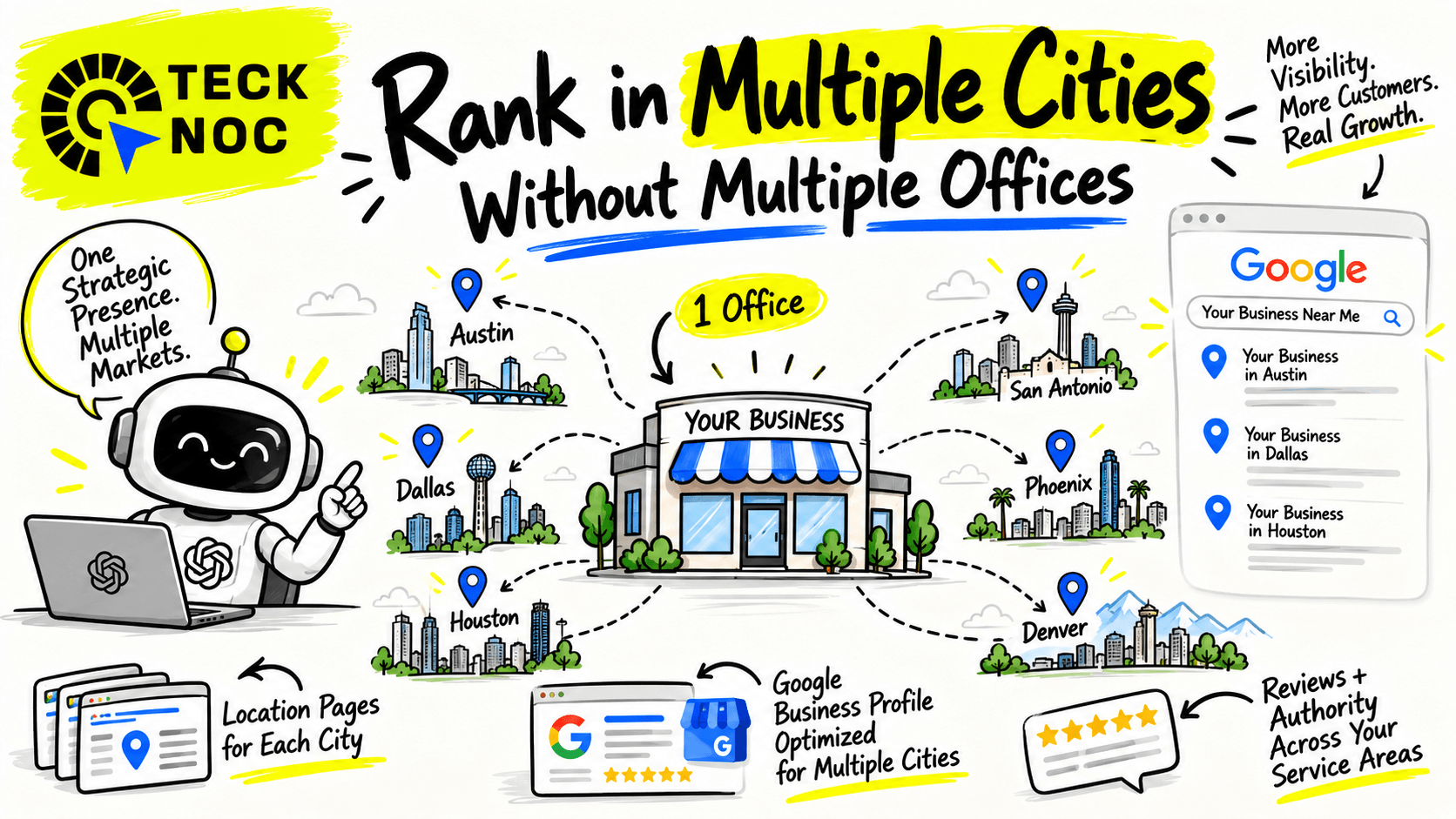
Creating dozens of pages that only swap the city name is not a strong multi-location SEO strategy.
A useful location page needs genuine local relevance.
That includes real services, useful information, unique content, and a reason for the page to exist.
Chasing Traffic With No Business Value
More traffic is not automatically better SEO.
A business can rank for hundreds of unrelated informational keywords and still generate no enquiries.
The goal should be qualified visibility.
What Still Works in SEO in 2026?
A lot of the fundamentals still work.
What has changed is how well they need to be executed.
Strong SEO still includes:
- technically accessible websites
- clear website structure
- useful service pages
- good internal linking
- relevant backlinks
- original content
- strong local signals
- Google Business Profile optimization
- genuine customer reviews
- clear business information
- fast, usable pages
- trustworthy branding
- content that answers real search intent
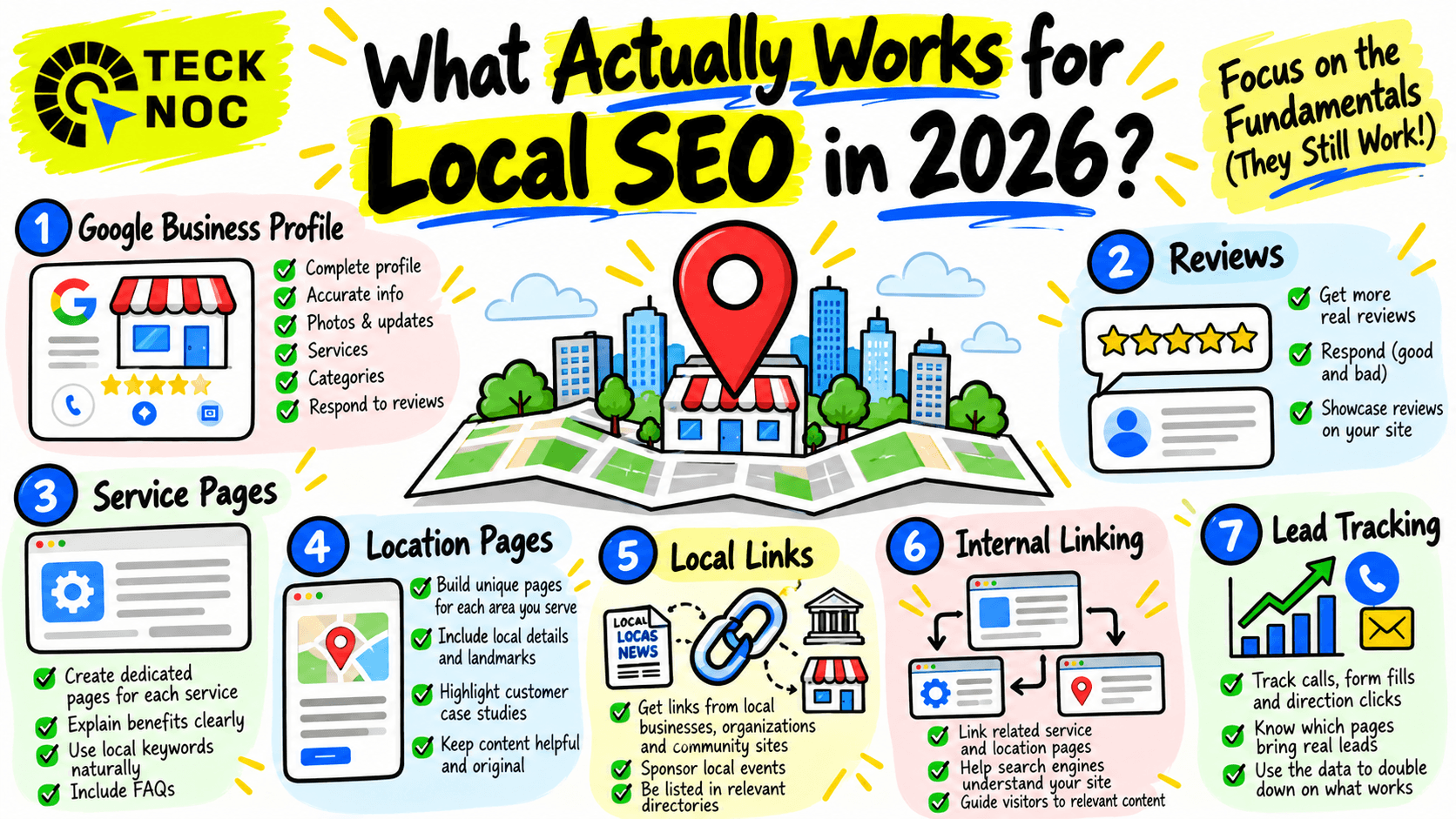
For local businesses, we have already broken down many of these fundamentals in what works for local SEO in 2026.
The fundamentals are not disappearing.
Weak execution is becoming easier to expose.
Is SEO Becoming “Search Everywhere Optimization”?
In practice, yes.
You do not necessarily need a new label for it.
But the concept is useful.
Businesses need visibility across more places than they did before.
That can include:
- Google Search
- Google Maps
- Google AI Overviews
- Google AI Mode
- ChatGPT
- Gemini
- Perplexity
- YouTube
- social platforms
The important question is not:
Are we ranking for one keyword?
It is:
Are we visible when our ideal customer is looking for what we sell?
That is a much better way to think about SEO in 2026.
Does SEO Still Drive Leads?
Yes, when the strategy targets the right searches.
Traffic by itself does not pay the bills.
Leads and customers do.
Imagine two websites.
Website A gets 10,000 organic visitors every month but generates two enquiries.
Website B gets 1,000 organic visitors and generates 30 enquiries.
Website B has less traffic.
But it has much more business value.
Modern SEO should measure:
- qualified visitors
- phone calls
- form submissions
- bookings
- sales
- assisted conversions
- local enquiries
That is why organic search marketing should be connected to conversion, not just rankings.
Is Traditional Google Search Losing Importance?
It is becoming one part of a larger search ecosystem.
That does not mean Google Search is irrelevant.
It means businesses should avoid depending entirely on one result format.
Someone may discover your company in Google Search.
Then check your reviews in Maps.
Then visit your Instagram.
Then ask ChatGPT to compare options.
Then return to your website and make contact.
Which channel gets the credit?
That is becoming harder to answer.
But all of those touchpoints matter.
SEO increasingly supports the whole discovery process.
What About AI Overviews?
AI Overviews are a perfect example of SEO changing rather than disappearing.
For some queries, Google now provides an AI-generated summary before the traditional organic results.
That can reduce clicks for basic informational questions.
But businesses can also gain visibility when their content, brand, or website is referenced in those answers.
So the strategy changes.
Instead of only asking:
How do we rank first?
businesses also need to ask:
How do we become a useful source that search engines and AI systems trust?
That requires strong content, clear information, authority, and relevance.
Is AI SEO Different From Traditional SEO?
Some parts are different.
The foundations are very similar.
Traditional SEO and AI visibility both benefit from:
- clear content
- well-structured pages
- credible information
- strong authority
- trustworthy branding
- consistent business information
- useful answers
- contextual relevance
AI search adds another layer.
Instead of focusing only on ranking positions, businesses also care about whether they are mentioned, cited, or recommended in generated answers.
You can read more in our guide to Regular SEO vs AI SEO.
Is SEO a Thing Anymore?
Yes.
SEO is still relevant because customers still search.
What has changed is where they search and how answers are presented.
Traditional organic rankings are only one part of modern search visibility.
SEO now overlaps with:
- local SEO
- AI search
- content
- technical optimization
- brand authority
- reviews
- conversion
- digital PR
The terminology may evolve.
The business need remains the same.
Companies still need to be discoverable when customers are looking for them.
Does SEO Still Matter in 2026?
Yes, especially if your customers research products, services, problems, or local businesses online.
SEO can still help businesses appear for:
- commercial searches
- service searches
- local searches
- Maps results
- informational questions
- comparison searches
- AI-generated answers
The important shift is focusing less on vanity traffic and more on qualified visibility.
A page does not need 100,000 visitors to be valuable.
It needs the right visitors.
Is SEO Still Worth the Investment in 2026?
For businesses whose customers search online, it can be.
But SEO is not automatically profitable.
Results depend on:
- market demand
- competition
- website quality
- strategy
- execution
- conversion rate
- business model
- time horizon
SEO also usually works best as a compounding channel.
A strong service page, helpful guide, or local landing page can continue generating visibility long after the initial work is completed.
That is different from paid advertising, where visibility usually stops when spending stops.
The two channels can work together.
They simply work differently.
What Should Businesses Do Instead of Declaring SEO Dead?
Focus on what search engines and customers actually need.
A practical 2026 strategy looks like this:
- Keep your website technically healthy.
- Build strong service and commercial pages.
- Answer real customer questions.
- Improve your Google Business Profile.
- Earn genuine reviews.
- Build relevant links and brand mentions.
- Publish original content with real expertise.
- Improve visibility in AI search as well as traditional search.
- Track leads, not just keyword rankings.
- Improve conversion after visitors arrive.
That is a much better use of time than debating whether SEO is alive or dead.
Will SEO Exist in 5 Years?
Most likely, yes.
It may not look exactly like SEO today.
Search interfaces will continue to change.
AI-generated answers may become more prominent.
Some traditional ranking metrics may become less important.
New discovery platforms will appear.
But businesses will still have the same basic problem:
How do we make sure people can find us when they are looking for what we offer?
As long as that problem exists, some form of SEO will exist.
The tactics may change.
The platforms may change.
The name may even change.
The underlying need will not.
What Does the Future of SEO Look Like?
The future of SEO is broader than rankings.
It is likely to involve a combination of:
traditional search + AI visibility + local search + brand authority + useful content + user experience + conversion
Businesses will need to think less about:
How do we rank number one for this exact phrase?
and more about:
How do we become one of the most trusted and visible answers wherever our customers search?
That is a healthier strategy anyway.
Final Thoughts: SEO Is Not Dead. Bad SEO Is.
SEO is not disappearing.
It is becoming harder to fake.
Businesses can no longer rely as heavily on keyword stuffing, generic content, thin location pages, random backlinks, and publishing simply for the sake of publishing.
Search engines and AI systems are both moving toward useful, trustworthy, clearly structured information.
That is good news for businesses willing to build something valuable.
If your SEO strategy focuses on helping real customers find, understand, trust, and choose your business, there is still plenty of opportunity in 2026.
SEO did not die.
It evolved.
Need an SEO Strategy That Works in 2026?
SEO has changed, and your strategy needs to change with it.
TeckNoc helps businesses improve visibility across traditional Google Search, local search, content, and emerging AI search experiences without relying on outdated tactics.
If you want a strategy focused on qualified traffic, stronger visibility, and real business growth, explore our SEO services in Texas or speak with our team about your current search performance.
FAQs
Is SEO dead in 2026?
No. SEO is still relevant in 2026, but the way it works has changed. Businesses now need to think beyond traditional rankings and consider local search, AI search, brand authority, useful content, and conversion.
Is SEO a thing anymore?
Yes. Businesses still need to make their websites and online information easy to find and understand. The platforms and tactics are evolving, but search visibility is still important.
Is AI replacing SEO?
No. AI is changing SEO rather than replacing it. AI systems still rely on websites, public information, trusted sources, brands, and structured content to answer questions and recommend businesses.
Does SEO still matter in 2026?
Yes, especially for businesses whose customers search online before buying, booking, calling, or visiting. The focus should be on qualified visibility and leads rather than traffic alone.
Has AI killed SEO?
No. AI has changed how some searches are answered and may reduce clicks for certain queries, but businesses still need strong websites, useful content, authority, and visibility across search platforms.
Is SEO still worth it in 2026?
It can be, particularly when SEO targets commercially relevant searches and the website converts visitors into leads or customers. Results depend on the market, competition, strategy, execution, and conversion rate.
Does SEO still work?
Yes. Strong service pages, technical SEO, relevant content, local optimization, reviews, useful internal links, and credible authority can still improve search visibility.
Will ChatGPT replace Google Search?
It is too early to know exactly how search behavior will develop. AI assistants are becoming an important discovery channel, but traditional search, Maps, video, social platforms, and websites continue to serve different search needs.
Is traditional SEO becoming obsolete?
Some traditional tactics are becoming less useful, but the fundamentals are not obsolete. Technical accessibility, helpful content, authority, relevance, and good user experience remain important.
What SEO tactics no longer work well?
Keyword stuffing, thin city pages, mass-produced generic content, random backlink buying, and publishing content purely to manipulate rankings are increasingly weak strategies.
What still works in SEO?
Useful service pages, technically healthy websites, original content, genuine authority, good internal linking, relevant backlinks, reviews, local optimization, and content that matches real search intent.
Will SEO exist in 5 years?
Most likely, yes, although it may look different. As long as people use search systems to find information, businesses, products, and services, companies will need ways to make themselves discoverable.
What is the future of SEO?
The future is likely to combine traditional SEO, AI search visibility, local search, brand authority, useful content, user experience, and conversion optimization.