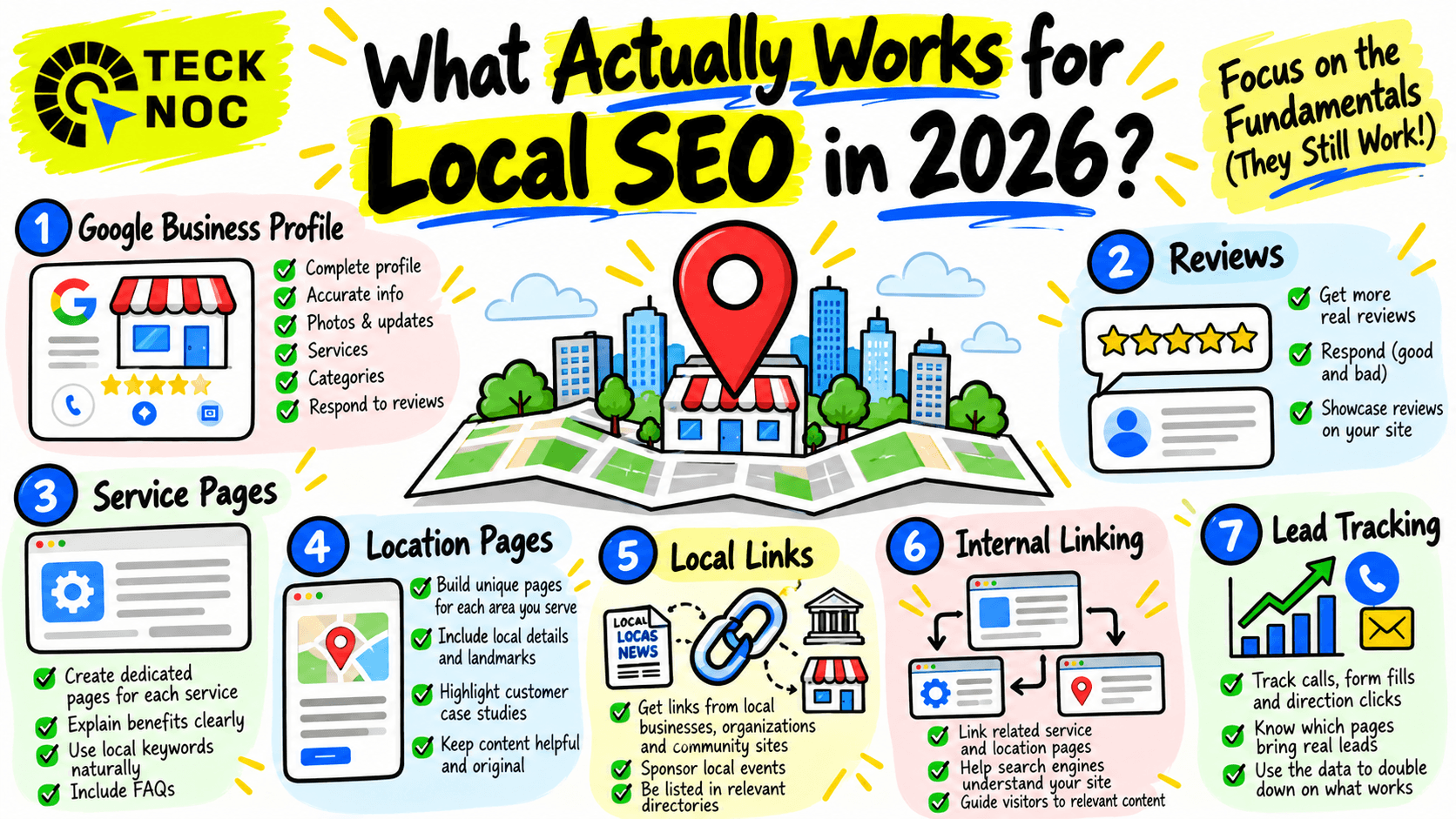
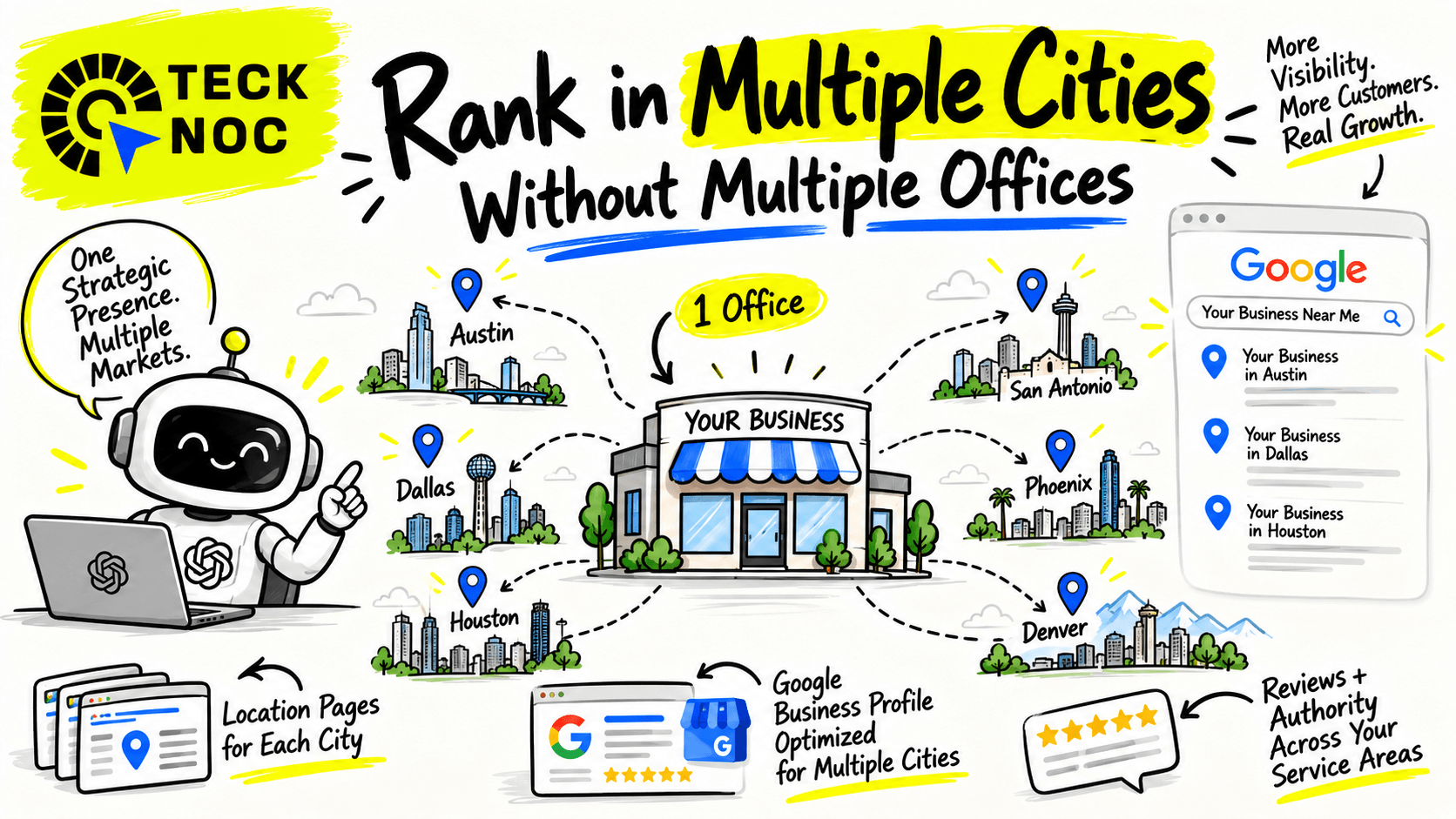
Quick Answer: If you want to know how to rank in multiple cities with one business location, the answer is to build genuine relevance in the places you actually serve. Create useful location pages, strengthen your Google Business Profile, earn reviews and local authority, and connect your service pages properly. You do not need an office in every city to compete in organic search, although Google Maps rankings are more affected by the physical distance between the searcher and your business.
Consider an HVAC company based in Austin that regularly serves customers in Round Rock, Cedar Park, Pflugerville, and Georgetown.
The company does not need four additional offices simply because customers search for HVAC services in those cities.
What it does need is clear evidence that it genuinely serves those markets.
That is the foundation of a good multi city local SEO strategy.
Can You Rank in Multiple Cities With One Location?
Yes, particularly in Google’s normal organic search results.
A business can create dedicated pages for nearby cities it genuinely serves. If those pages answer local search intent well and the website has enough relevance and authority, they can appear for searches outside the company’s home city.
For example, an Austin based HVAC company could have pages targeting:
- HVAC services in Round Rock
- HVAC services in Cedar Park
- HVAC services in Georgetown
These pages do not require separate offices.
However, organic rankings and Google Maps rankings should not be treated as the same thing.
Organic Rankings and Google Maps Rankings Work Differently
This is one of the most important points to understand.
A useful location page may rank organically for a search such as:
“HVAC company Round Rock”
even when the company’s main office is in Austin.
Google Maps is different because the location of the searcher matters more.
Google explains that local rankings depend mainly on relevance, distance, and how prominent or well known a business is. Distance means a company that is much farther from the person searching may find it harder to compete in the local Map Pack. Google explains these local ranking factors here.
That does not mean proximity is the only factor. Reviews, business information, links, relevance, and authority also contribute.
Our guide to local SEO ranking factors explains these signals in more detail.
You can build organic relevance in another city, but a location page cannot physically move your business closer to the searcher.
Create Useful Pages for the Cities That Matter
A dedicated location page can help Google understand that your business provides a particular service in a particular area.
But that does not mean you should create a page for every town within 100 miles.
Start with locations that have real business value and that you genuinely serve.
A roofing company might create:
/roofing-round-rock/
/roofing-cedar-park/
/roofing-georgetown/
Each page should help someone in that location decide whether the company is relevant to them.
Useful information could include the services available in that city, neighborhoods covered, common customer questions, relevant projects, service availability, local testimonials, and information about how the company works in that area.
The important word is useful.
A location page should have a reason to exist beyond targeting a city keyword.
Do Not Duplicate the Same Page Across 20 Cities
This is where many businesses get multi city SEO wrong.
They create one good Austin page, duplicate it several times, and replace “Austin” with “Dallas,” “Plano,” “Frisco,” or another city.
The URLs may be different, but the experience for the reader is almost identical.
That creates very little local value.
Instead, look for genuine differences between the locations.
Perhaps customers in one market commonly need a particular service. Maybe you have completed projects in specific neighborhoods. Perhaps local properties have different characteristics or customers ask different questions.
Use those differences where they are real.
Our guide to common local SEO mistakes explains why thin and repetitive local pages can weaken an otherwise reasonable SEO strategy.
When Can City Pages Become Doorway Pages?
Having several location pages is not automatically a problem.
The issue is how and why those pages are created.
Google’s spam policies warn about pages created for very similar searches that mainly funnel visitors toward the same destination. Its examples include pages targeting different cities or regions when those pages offer little independent value. Google explains doorway abuse in its spam policies.
That is why creating 100 almost identical location pages simply to capture 100 city names is risky.
A useful question to ask is:
Would this page still help a customer if Google did not exist?
If someone in that city can learn something useful about your service, availability, experience, or local work, the page has a legitimate purpose.
If the only difference is the city name in the heading, it probably needs more work.
Use Google Business Profile Service Areas Correctly
Your Google Business Profile is an important part of local SEO, but service areas are often misunderstood.
Google currently allows service area businesses to specify up to 20 service areas. Google also advises that the overall service area generally should not extend more than about two hours of driving time from where the business is based. Google explains service area settings here.
Adding those areas helps Google and customers understand where the company provides services.
It does not mean the business will automatically rank throughout every selected city.
For example, adding Dallas, Houston, Austin, and San Antonio to a profile would not automatically create strong Map Pack visibility throughout Texas.
The areas should accurately reflect where you genuinely operate.
Your profile should also have accurate categories, services, contact information, photos, hours, and other relevant business details.
Our guide to Google Business Profile and local SEO explains how the profile fits into a complete local search strategy.
Do You Need a Google Business Profile for Every City?
Usually, no.
Google says a service area business should generally have one profile for the area it serves. If a company has genuinely separate operating locations with separate staff and service areas, additional profiles may be eligible. Google outlines its Business Profile eligibility rules here.
This is different from creating additional addresses purely to improve rankings.
Google’s guidelines also state that a service area business cannot use a virtual office unless that office meets its eligibility requirements, including being staffed during business hours.
For most businesses with one real operating location, the safer strategy is straightforward:
Maintain one legitimate Business Profile and build organic relevance through your website for the other cities you serve.
Build Local Authority Beyond Your Own Website
Location pages become stronger when other online signals support what they say.
If your website claims you serve Round Rock, but there is no other evidence of activity there, the location relationship may be weaker.
Real local authority can come from relevant business directories, community organizations, local partnerships, sponsorships, trade associations, supplier relationships, local publications, and genuine backlinks.
Customer reviews can also reinforce geographic relevance.
The goal is not to manufacture links or citations.
It is to make your real business activity visible online.
A company with customers, reviews, partnerships, and mentions across several nearby cities gives search engines much stronger evidence that it genuinely serves those areas.
Encourage Reviews From Customers Across Your Service Area
Reviews are especially useful for service businesses because customers often naturally mention the service and location.
For example:
“They replaced our air conditioning system in Cedar Park and explained everything clearly.”
That review gives potential customers useful information about where the company works.
You should not give customers a keyword filled script or tell them exactly what to write.
Simply ask for honest feedback.
Over time, genuine reviews from different parts of your service area can help people see that your company regularly works outside its home city.
Connect Your Location Pages With Internal Links
Good location pages should not be isolated.
Users and search engines need a logical way to find them.
A simple structure might be:
Homepage → Main Service → Relevant Location Page
For example:
HVAC Services → HVAC Round Rock
or
Landscaping Services → Landscaping Georgetown
Relevant blog posts can also link to those pages when the connection makes sense.
Avoid putting dozens of keyword heavy city links into every page simply because you want those locations indexed.
Internal links should help explain the relationship between your services and the areas you serve.
Building this type of structure is part of the work involved in professional SEO services in Texas when a company wants to expand beyond one local market.
Can You Use Automation to Create Location Pages?
Yes, but automation needs human judgment.
Businesses operating across many legitimate markets may use templates, structured data, databases, or other tools to make page creation more efficient.
The danger is scale without value.
Google’s spam policies specifically warn against creating large amounts of unoriginal content primarily to manipulate search rankings, regardless of whether it is produced manually, through scripts, or with generative AI. See Google’s spam policies.
Automation should therefore handle repetitive work while the final pages still provide useful information.
If a company needs to build a large number of legitimate landing pages, our guide to programmatic SEO explains how scalable page creation can be approached without simply producing duplicates.
How Long Does It Take to Rank in Another City?
There is no universal timeline.
A nearby town with limited competition may be easier to enter than a major city where established companies have strong websites, hundreds of reviews, and years of local authority.
Results can depend on factors such as:
- existing website authority
- local competition
- content quality
- backlinks and citations
- reviews
- geographic relevance
- the strength of competing businesses
This is why promises such as “rank in every Texas city in 30 days” should be treated carefully.
No SEO company controls Google’s rankings.
A better strategy is to identify the markets most likely to generate business and build visibility there one market at a time.
A Simple Texas Example
Imagine an HVAC company based in Austin that regularly serves Round Rock, Pflugerville, Cedar Park, and Georgetown.
A sensible strategy could include one eligible Google Business Profile, strong core HVAC service pages, dedicated location pages for the most important nearby markets, genuine reviews from customers across the service area, local authority signals, and clear internal links.
The company would not need to pretend it has offices where none exist.
It also would not need to create four identical pages.
Instead, the website would give Google and potential customers clear evidence of where the company operates and what it provides in each market.
That is what multi city local SEO should accomplish.
Final Thoughts: How to Rank in Multiple Cities Without Multiple Offices
You can rank your business in multiple cities without opening an office in every location.
The strategy is not about creating as many city pages as possible.
It is about building genuine relevance in the places where you actually do business.
Create useful location pages. Keep your Google Business Profile accurate. Earn real reviews and local authority. Use sensible internal links. Focus first on markets that can actually generate customers.
And remember the difference between organic search and Google Maps.
Organic SEO gives a business more flexibility to target nearby cities.
Map Pack visibility remains more sensitive to physical distance.
A strong local SEO strategy works with that reality rather than trying to manipulate it.
Need Help Expanding Into More Texas Markets?
Expanding search visibility beyond your home city requires more than adding city names to a website.
TeckNoc’s SEO services in Texas can help businesses plan location pages, improve website structure, strengthen local authority, and build a strategy around the markets that matter most.
Businesses looking for SEO alongside paid search, content, web design, and wider customer acquisition can also work with TeckNoc as a digital marketing company in Texas.
Request a Consultation
FAQs
Can I rank in multiple cities with one business location?
Yes. A business can rank organically in several cities from one location when it genuinely serves those areas and creates useful, relevant location content. Google Maps visibility may vary more because distance remains an important factor in local search.
Do I need an office in every city I want to rank in?
No. Businesses can compete organically in cities where they provide genuine services without maintaining an office in each one.
Should I create a page for every city I serve?
Not necessarily. Prioritize locations with real search demand and business value where you can create a genuinely useful page. Avoid creating thin pages for every nearby town simply to target additional keywords.
Does adding a service area to Google Business Profile make me rank there?
No. Adding a service area accurately tells Google where you operate, but it does not guarantee rankings. Relevance, distance, prominence, competition, and other local signals still affect visibility.
Can one Google Business Profile appear in multiple cities?
Yes, a service area business may appear across more than one area, but visibility can vary considerably depending on where the searcher is located and how strong the competition is.
Are multiple city pages bad for SEO?
No. Location pages can be valuable when each page serves a genuine customer need. Problems arise when large numbers of substantially similar pages are created mainly to target different city keywords.
Can I use a virtual office to rank in another city?
A Business Profile must comply with Google’s eligibility rules. A virtual office that is not genuinely staffed and operated as an eligible business location should not be used simply to create another local listing.